
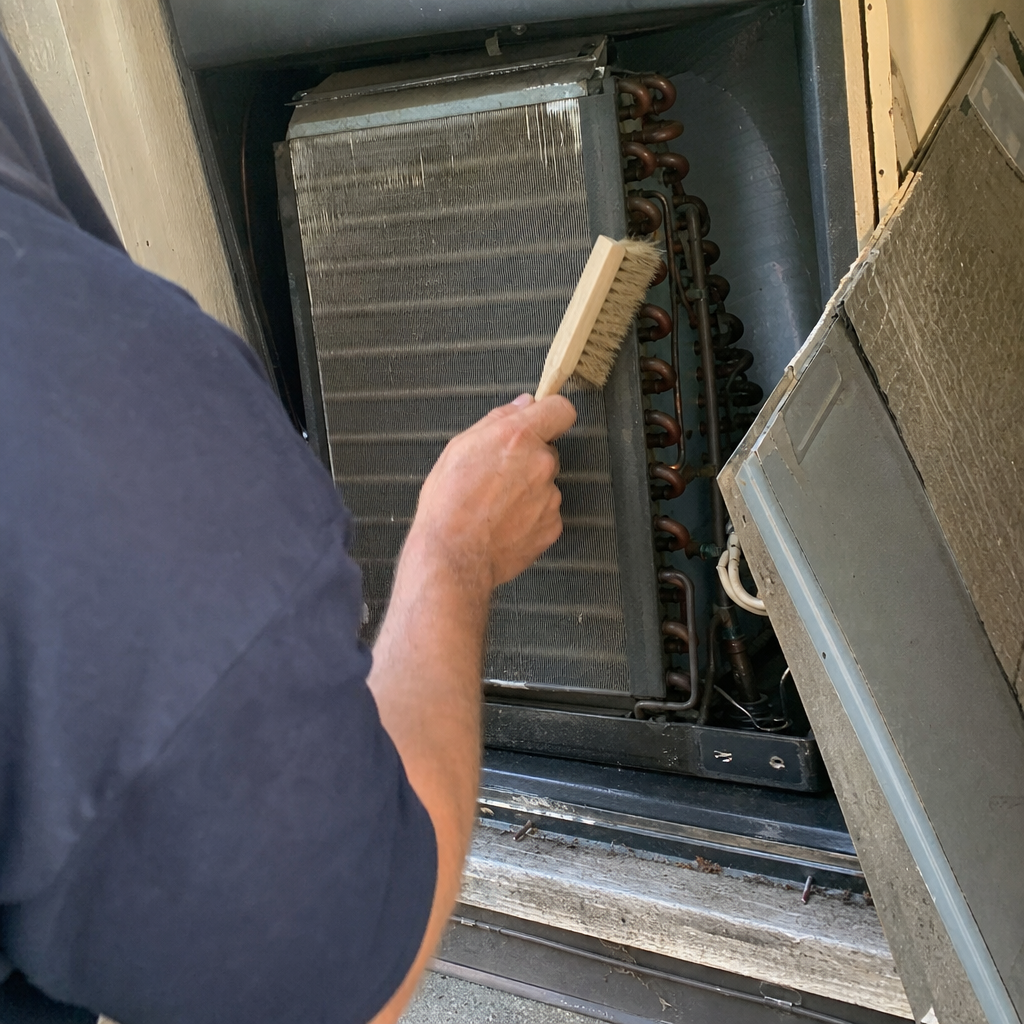
How Often to Clean Air Ducts in Hartford, CT: It Depends on Where You Live
Most homes need air duct cleaning every 3 to 5 years, but in Hartford’s pre-1940 housing stock — triple-deckers in Frog Hollow, two-families in the South End, retrofit systems throughout Blue Hills — we often recommend starting with a baseline inspection to establish what’s actually in there, then setting a maintenance cycle based on what we find. If your building was converted from radiator heat to forced air decades ago and the ducts have never been professionally cleaned, the 3-to-5-year clock doesn’t start fresh; it starts with catching up. See our guide on how much air duct cleaning costs in Hartford, CT, then call (844) 923-4376 and we’ll tell you what we find, not just what we charge.
Why Hartford’s Housing Makes “Standard” Frequency Guidelines Misleading
The 3–5 year rule you’ll see on most home-maintenance sites assumes a purpose-built forced-air system in a single-family home with standard duct geometry, accessible registers, and documented service history. That describes maybe a third of the residential buildings we work on in Hartford.
Walk into a triple-decker on Flatbush Avenue or New Britain Avenue — the kind that dominates Frog Hollow, Clay-Arsenal, and stretches of the South End — and you’re looking at a fundamentally different mechanical situation. These buildings went up in the 1890s to 1920s for steam or hot-water radiator heat. When central air came later, often in the 1970s or 1980s, contractors ran flex duct through original plaster walls, closet chases, and vertical cavities never engineered for airflow. The result: sharp bends that trap debris, dead-leg branches with no return airflow, and access points that don’t match any standard equipment sizing.
We’ve pulled out decades of accumulated material from systems that were “cleaned” by previous owners with a shop vacuum pushed through a floor register. That doesn’t touch the vertical runs stuffed through 1910s plaster. In these conditions, the question isn’t “how long since the last cleaning?” — it’s “Is Air Duct Cleaning Worth It? (Hartford, CT) for a system that may never have been properly cleaned at all?”
Steven Ramirez, our Owner & Lead Technician, grew up in Hartford’s Parkville neighborhood and still lives within ten minutes of most homes we service. He’s documented enough of these retrofit systems to know that a visual inspection through a standard register opening tells you almost nothing about what’s collecting in the wall chases above. That’s why we start with a full-system assessment using our Air Duct Cleaning protocol before recommending any frequency schedule.
Two Different Questions: Establishing Baseline vs. Maintaining a Clean System
Homeowners in Hartford are really asking two different things when they search “how often to clean air ducts,” and conflating them leads to bad decisions.
Phase One: The Baseline Assessment (For Homes With Unknown or No Service History)
If you’ve moved into a pre-1940 Hartford building and there’s no documentation of prior duct cleaning — which describes most of the South End and Blue Hills inventory — you’re not on a maintenance cycle yet. You’re in discovery mode.
We use professional-grade Rotobrush and Nikro equipment with cameras and variable-diameter brushes to navigate non-standard duct configurations. What we typically find in first-time assessments:
- Construction debris from original HVAC retrofit (plaster dust, wood shavings, fasteners) still sitting in low-velocity sections decades later
- Layered dust loads compressed by humidity cycles into dense matting that restricts airflow
- Evidence of prior pest intrusion in basement trunk lines — common in older Hartford buildings with stone foundations
- Disconnected flex runs blowing conditioned air into wall cavities instead of living spaces
The baseline assessment determines whether you’re starting from a clean state or need an intensive initial cleaning before any regular schedule makes sense. We’ve had customers in Clay-Arsenal two-families where the initial cleaning removed material that had been accumulating since the Reagan administration. Their “every 3 years” maintenance cycle started after that, not before.
Phase Two: The Maintenance Cycle (For Systems With Documented Clean State)
Once a system has been thoroughly cleaned and documented, we can set a rational frequency based on actual conditions rather than calendar guessing. For Hartford homes with established baselines, here’s how we segment it:
| Housing Type & Conditions | Recommended Cleaning Frequency | Key Triggers to Watch For |
|---|---|---|
| New construction or purpose-built forced air (West Hartford, Bloomfield suburbs) | Every 4–5 years | Visible dust at registers, airflow reduction, allergy season intensity |
| Pre-1940 retrofit with standard occupancy, no pets | Every 2–3 years | Humidity odors in fall, register discoloration, uneven heating/cooling room-to-room |
| Pre-1940 retrofit with pets, recent renovation, or multiple occupants | Every 1.5–2 years | Post-renovation dust recurrence, pet hair at returns, persistent stuffiness |
| Multi-unit buildings with shared trunk lines | Annual inspection; cleaning every 1–2 years depending on neighbor turnover | Cross-unit odors, humidity pooling in basement trunks, visible debris at common returns |
These aren’t arbitrary numbers. They’re based on 14 years of documenting what we actually pull out of Hartford systems at different intervals, matched to how this city’s specific conditions accelerate or slow accumulation.
How Hartford’s Connecticut River Valley Humidity Changes the Math
Here’s a local factor that national guidelines never account for: Hartford sits in a thermal trough that makes our summers measurably hotter and more humid than coastal Connecticut. New Haven might hit the same temperature on a given July afternoon, but our humidity load — and how long it persists overnight — is consistently higher.
That matters for ductwork because cooling season is when biofilm growth accelerates. When your AC runs, the evaporator coil and nearby duct surfaces drop below the dew point. In high-humidity conditions, that moisture lingers longer in low-velocity sections — exactly the dead-leg branches common in Hartford retrofit systems. The result: a film of biological material that dust particles stick to, creating a substrate that doesn’t just collect debris but actively grows it.
This is why we recommend a fall inspection as a genuine annual checkpoint, not a marketing upsell. After a humid Hartford summer, we can camera-inspect the evaporator-adjacent ductwork and the low-velocity branches that are most prone to biofilm. If we find growth, we clean before heating season recirculates it. If we don’t, you’ve got documentation that extends your cleaning interval with confidence.
We’ve worked with premium air-quality equipment from Honeywell and Aprilaire that includes humidity monitoring, and the data consistently shows Hartford interiors running 10–15% higher indoor relative humidity than comparable coastal properties during July and August. That translates directly to different duct maintenance needs.
The Pet and Renovation Accelerants: Real Hartford Scenarios
Two conditions compress cleaning frequency that generic guidelines underestimate: multiple pets and recent renovation work. Both are common in Hartford’s dense older neighborhoods, and both change the accumulation rate meaningfully.
Pet hair is particularly problematic in retrofit duct systems because the irregular geometry that characterizes Hartford’s converted housing creates more turbulence points where hair tangles and traps dander. In a standard ranch with straight trunk-and-branch ductwork, hair moves through more predictably. In a South End triple-decker where flex duct makes two 90-degree turns through a former chimney chase, you’ve got collection points that standard residential vacuums can’t reach.
Renovation debris is the other accelerant we see constantly. Hartford’s older housing stock means more active remodeling — homeowners opening up walls, refinishing floors, replacing plaster with drywall. Even with contractors who seal registers, fine particulate gets into the system. Drywall dust in particular is abrasive and electrostatically charged; it clings to duct surfaces and attracts subsequent layers. We’ve done baseline assessments in recently renovated Frog Hollow homes where the “clean” system was carrying months of construction residue that the previous owner’s contractor never addressed.
For homes with either condition — pets or recent renovation — we typically move the maintenance interval up by 12 to 18 months from the base recommendation. The Affordable Air Duct Cleaning in Hartford, CT cost of more frequent service is offset by reduced HVAC strain and documented indoor air quality improvement.
What Steven Documents — And Why It Replaces Calendar Guessing
Steven Ramirez leads every job personally, and part of that accountability is photographic documentation of what we find. After 14 years of owner-operated work in Hartford, he’s built a reference library that lets repeat customers make informed decisions about timing rather than guessing from a calendar.
Here’s how that plays out in practice: A customer in Blue Hills had us clean in 2019. Steven documented moderate dust load, no biofilm, good flex connections. We recommended 3-year interval. In 2022, inspection showed faster accumulation than expected — turned out a new dog and a bathroom renovation had changed the inputs. We cleaned and reset to 2-year cycle. In 2024, inspection showed the 2-year cycle was holding steady; we confirmed the interval rather than pushing unnecessary service.
This is the difference between a technician who tells you what he found and one who sells you a calendar slot. Our 1,074 verified reviews at a 4.9-star average reflect that consistency — customers know the recommendation is tied to their actual system condition, not a revenue target.
We use industrial-grade Rotobrush and Nikro equipment with camera systems that let us show you what we’re seeing in real time. When Steven says a section needs attention, he can show you the image. When he says you’re good for another year, he’s got the documentation to back it.
Key Takeaways: Your Hartford Duct Cleaning Frequency
- If you don’t know your system’s history, start with a baseline assessment — don’t assume the 3–5 year guideline applies to you
- Pre-1940 retrofit housing in Hartford’s core neighborhoods typically needs more frequent attention than purpose-built suburban construction
- Connecticut River Valley humidity makes fall inspection a logical annual checkpoint, especially after heavy cooling seasons
- Pets and recent renovations are genuine accelerants that should shorten your interval by 12–18 months
- Documented condition assessment beats calendar guessing — know what’s actually in your system before deciding when to clean next
FAQs
Schedule a camera inspection if you have no service records, notice uneven heating or cooling room-to-room, see dust accumulating rapidly after cleaning, or smell mustiness when the system first kicks on — these are the most reliable indicators in older Hartford housing that something’s worth checking. We offer no-pressure assessments; call (844) 923-4376 and we’ll show you exactly what we find before recommending any service.
Retrofit systems can take 20–40% longer to clean properly because of non-standard access points and irregular geometry, but we quote upfront based on inspection, not surprise you after we’re inside — our assessment identifies these conditions before work begins. The alternative of skipping it because of assumed Whole House Air Duct Cleaning Cost in Hartford, CT usually means higher HVAC energy bills and accelerated equipment wear that costs more long-term. Call (844) 923-4376 for a free estimate specific to your building.
A shop vacuum can remove surface debris at floor-level registers but cannot reach vertical wall chases, trunk lines in basements or attics, or the evaporator coil area where biofilm typically forms — in Hartford’s retrofit systems, that’s where the actual problem usually lives. We don’t recommend DIY attempts on these components; our professional-grade equipment and 14 years of navigating non-standard configurations are what make the difference between cosmetic cleaning and actual system improvement. Call (844) 923-4376 if you’d like to understand what your specific system would involve.
Hartford’s Connecticut River Valley location creates higher sustained humidity than coastal cities like New Haven or Bridgeport, which means more moisture retention in ductwork during cooling season and faster biofilm growth in low-velocity sections common in retrofit housing — this is why we emphasize fall inspection as a genuine local necessity rather than a routine upsell. The difference is measurable in indoor relative humidity readings and visible in the condition of systems we assess. If you’re unsure whether your summer humidity has affected your ducts, call (844) 923-4376 for a post-season check.
Ready to Know What’s Actually in Your System?
If you’d rather have it looked at than guess from a calendar, Empire Air Duct Cleaning Service Greater Hartford offers a no-pressure assessment — Steven Ramirez will show you what he finds and recommend a frequency based on your actual conditions, not a generic guideline. We’ve earned our 4.9-star rating across 1,074 reviews by telling homeowners what we found, not just what we charged. Call (844) 923-4376 for a free estimate in Hartford.
Written by Steven Ramirez, Owner & Lead Technician at Empire Air Duct Cleaning Service Greater Hartford, serving Hartford, CT.