
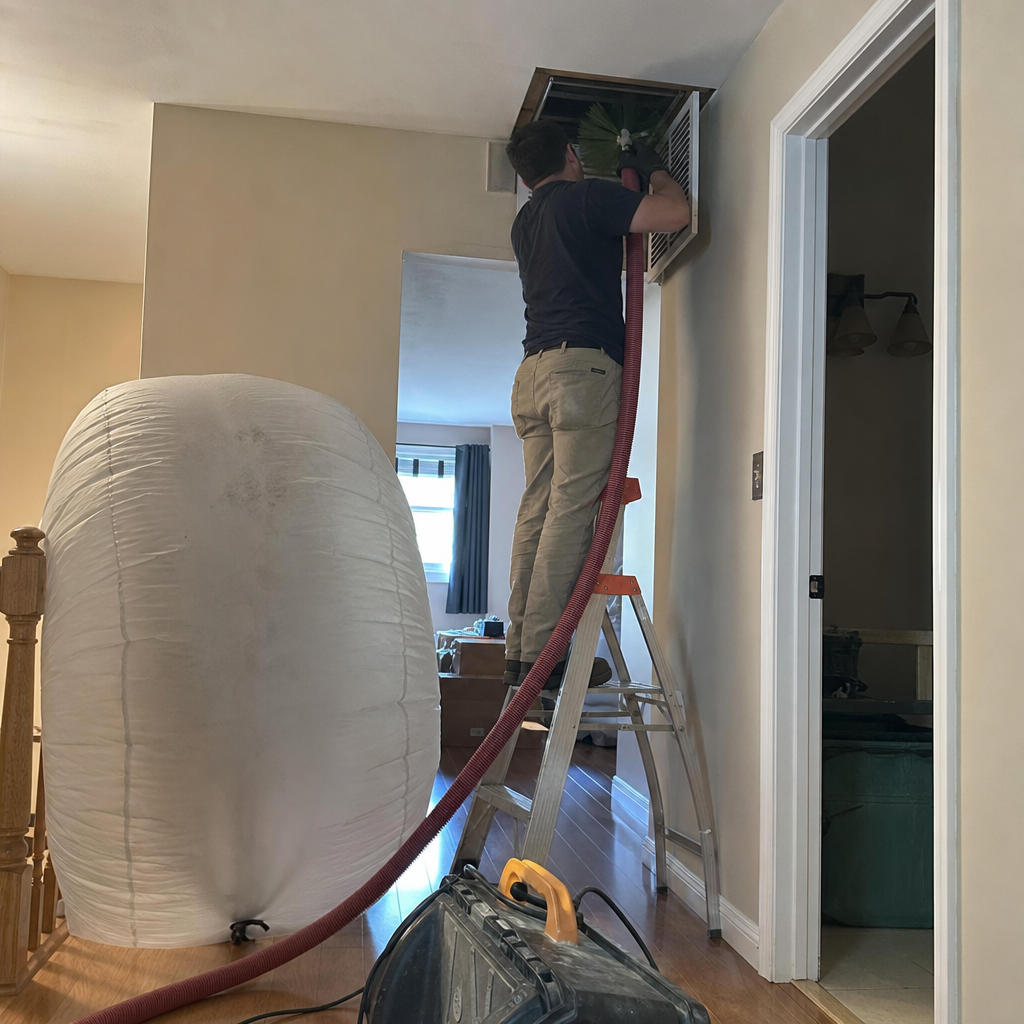
Signs You Need Dryer Vent Cleaning in Hartford, CT — Before the Fire Risk Builds
The clearest signs you need dryer vent cleaning are clothes that come out hot but still damp, a laundry room that feels noticeably warmer than the rest of your home, and lint collecting behind your dryer faster than it used to. In Hartford’s older multi-family buildings — where vent runs often stretch 20 feet through interior walls with multiple elbows — these early warning signals appear sooner and mean more than they would in a suburban ranch with a straight 6-foot run. If you’re seeing any of these, call (844) 923-4376 for a free assessment; in a triple-decker with shared chases, waiting for the “classic” warnings like a burning smell can mean waiting too long.
Why Hartford’s Housing Stock Changes What “Normal” Looks Like
Most dryer vent checklists were written with new construction in mind — short run, exterior wall termination, easy visual check. That model doesn’t map onto what we find in Frog Hollow, the South End, or along Flatbush Avenue, where the dominant housing stock is pre-1940 triple-deckers and two-family wood-frames originally built for steam radiator heat.
When these buildings were converted to forced air, ductwork and venting were retrofit through plaster walls, closet chases, and vertical cavities never engineered for it. A dryer vent in one of these units might run 15 to 25 feet horizontally through a shared interior wall, make three or four 90-degree turns, and terminate through a roof cap or into a common chase rather than a visible exterior wall. Each elbow in that run cuts effective airflow by the equivalent of several linear feet of straight pipe. A 20-foot run with four elbows performs more like a 40-foot run, and lint accumulates at a rate that short-run calculators simply don’t predict.
We’ve pulled compacted lint plugs from Hartford vents that would have seemed impossible given the dryer’s age. The configuration — not the appliance — was the problem.
The Early Signals Most Hartford Homeowners Miss
By the time you smell burning or your dryer exterior gets too hot to touch, you’ve already got a dangerous blockage. In our 14 years working Hartford homes, we’ve learned to watch for the quieter warnings that show up first:
- Clothes hot but damp at cycle end. This is back-pressure in action. Your dryer is heating, but moist air can’t escape fast enough to actually dry the load. In a long-run Hartford system, this appears months before the “classic” warnings.
- Lint accumulating behind the dryer faster than usual. When exhaust airflow drops, lint doesn’t all make it to the termination point. Some escapes through gaps in the transition duct and settles behind the unit. If you’re cleaning back there weekly instead of monthly, your vent is telling you something.
- The laundry area feels warmer than adjacent rooms. Heat is backing up into the space instead of leaving the building. In Hartford’s humid summers, that trapped heat also raises local humidity, which compounds the problem.
- Longer dry times that creep up gradually. Most people adapt incrementally — “it’s always been a little slow in this building” — and miss the deterioration. Track it: a standard load should not take more than 45-50 minutes.
- Visible lint at the exterior cap (when you can see it). But here’s the Hartford problem: many terminations are roof caps or interior chases with no visible exterior signal at all. A blocked interior termination gives zero external warning.
Steven Ramirez, our Owner & Lead Technician, put it plainly after a job on New Britain Avenue last spring: “I tell you what I found, not just what I charged.” In that case, what he found was a 22-foot horizontal run through a shared chase, packed solid with lint that had absorbed three summers of Hartford humidity and hardened into something a DIY brush kit would have just punched through without removing.
Why Hartford’s Climate Makes Blockages Worse — and Harder to Clear
Hartford sits in the Connecticut River Valley, which acts as a thermal trough. Summers here run measurably hotter and more humid than coastal Connecticut cities like New Haven or Bridgeport. That humidity matters inside your dryer vent in ways that short-run suburban systems don’t experience.
Lint is hydrophilic — it binds moisture from the air. In a long, partially blocked vent run, humid summer air gets trapped in the duct. The lint absorbs that moisture and compacts into dense, adhered plugs that resist simple mechanical brushing. We’ve extracted plugs from Hartford vents that felt closer to felted wool than loose fluff. A consumer-grade vent brush kit, the kind sold at hardware stores, will often punch a hole through the center of these plugs without actually removing the material. The vent tests “clear” with a brush through it, but the actual airflow improvement is minimal.
That’s why we run professional-grade Nikro extraction equipment on every job — the same tools commercial and industrial contractors rely on — rather than consumer-grade vacuums dressed up for residential work. The suction power and agitation range are designed for exactly these conditions. Combined with Rotobrush rotary systems for mechanical dislodging, we can clear compacted Hartford blockages that simpler tools leave behind.
The Roof-Cap and Interior-Chase Blind Spot
In newer construction, you walk outside, look at your exterior wall cap, and know whether lint is building up. In Hartford’s triple-deckers, that simple check often isn’t possible.
Roof terminations are common in multi-family buildings where exterior walls are either unavailable or shared. A roof cap can be completely blocked with no visible ground-level signal. Interior chases — vertical cavities shared by multiple units — are worse. Your lint may be joining your neighbor’s in a common space that nobody owns or checks. By the time back-pressure shows up in your dryer’s performance, the chase may have significant accumulation affecting multiple units.
We’ve opened interior chases in Clay-Arsenal buildings where the cross-section was reduced by more than half. No individual unit’s dryer was “the problem” — the shared infrastructure had never been serviced.
When “Normal for an Old Building” Becomes Dangerous
There’s a phrase we hear regularly in Hartford: “It’s always been like that.” Long dry times, a warm laundry room, a little lint behind the dryer — framed as character, not warning signs. But dryer fires are not a scare tactic. The National Fire Protection Association attributes 34% of home dryer fires to failure to clean. In a multi-family building with shared walls and common egress, that risk doesn’t stay in your unit.
The 14 years we’ve spent in Hartford homes have taught us that “normal for this building” often means “undiagnosed for decades.” When we inspect a dryer vent system, we’re not just clearing current blockage — we’re assessing whether the original installation, retrofit, or prior maintenance has left a configuration that will re-block quickly. In buildings where flex duct was stuffed vertically through 1910s plaster walls, the physical constraints may mean more frequent cleaning intervals than the standard annual recommendation.
What Professional Dryer Vent Cleaning in Hartford Actually Involves
Our Dryer Vent Cleaning process starts with airflow measurement — we want a baseline, not a guess. Then we inspect the full run with borescope cameras where accessible, identify elbows and transition points where lint concentrates, and select the right combination of mechanical agitation and extraction for what we find.
For Hartford’s compacted humidity plugs, that typically means Rotobrush rotary cleaning to break adhesion, followed by Nikro high-volume extraction to remove debris without pushing it deeper. We finish with post-cleaning airflow verification so you know the improvement is measurable, not just claimed.
Because Steven Ramirez leads every job personally — the person you book is the person who does the work — the assessment you get comes from 14 years of hands-on experience in Hartford’s specific building stock, not a training manual for standard suburban construction. He grew up in Parkville, a few blocks from the old Colt factory, and still lives within ten minutes of most homes we service. His mechanical foundation came from HVAC coursework at Manchester Community College, where the emphasis on airflow as a system rather than a collection of parts shapes how he evaluates every vent run.
Common Local Scenarios We See in Hartford
These aren’t hypotheticals — they’re patterns from jobs across the city:
- The Flatbush Avenue triple-decker. Twenty-foot horizontal run, four elbows, terminates through roof cap. Owner reported “a little slower than our old place” for two years. We found 70% airflow restriction from a compacted plug at the third elbow. Post-cleaning dry time dropped from 75 minutes to 38.
- The South End two-family with shared chase. Both units complaining of warm laundry rooms. Interior chase had never been accessed; lint accumulation from both dryers over 15+ years had reduced the common duct to less than 40% of original capacity.
- The Blue Hills condo conversion. Original 1920s building, HVAC retrofit in the 1990s. Dryer vent run through original plaster wall with no cleanout access. Required custom insertion angles and smaller-diameter equipment that wouldn’t be necessary in purpose-built construction.
- The Frog Hollow unit with “intermittent” problems. Humidity-dependent: fine in winter, terrible in July. Lint plug was absorbing summer moisture and expanding; winter’s dry air let enough air through to mask the restriction.
What It Costs to Wait vs. What It Costs to Clean
There’s no honest flat rate for dryer vent cleaning cost in Hartford because the actual work varies dramatically with access, run length, and blockage severity. What we can tell you: the cost of cleaning is predictable; the cost of a dryer fire or premature appliance replacement is not.
| Scenario | Typical Range | What Affects It |
|---|---|---|
| Standard single-family exterior-wall termination, light buildup | $150 – $220 | Run length under 10 feet, 1-2 elbows, direct access |
| Multi-family horizontal run with multiple elbows | $220 – $340 | Run length 15-25 feet, 3+ elbows, roof or chase termination |
| Severe blockage requiring mechanical dislodging + extraction | $280 – $400 | Compacted humidity plugs, interior chase access, camera inspection needed |
| Shared chase or multi-unit common duct | $350 – $550+ | Coordination with other units, extended access work, full-chase cleaning |
Estimates are free. We don’t charge to look, and we don’t upsell what you don’t need. Call (844) 923-4376 to schedule.
FAQs
A poorly designed vent and a clogged vent can produce identical symptoms — long dry times, heat backup, lint escape — but the solutions differ. If your vent has always performed badly since installation, design may be the primary issue: too many elbows, excessive run length, or improper termination. If performance degraded gradually, blockage is more likely. We measure airflow before and after cleaning to separate these; if cleaning doesn’t restore adequate flow, we’ll tell you the vent configuration itself needs modification. Call (844) 923-4376 for an assessment — estimates are free.
DIY brush kits run $20-$40, but in Hartford’s long-run, multi-elbow systems, they often make the problem worse. A brush pushed through a compacted humidity plug can create a passage that tests “clear” with airflow but leaves the actual blockage intact. We’ve been called after DIY attempts where the homeowner had “cleaned” the vent three times in two years with no real improvement. Professional cleaning with Nikro extraction and rotary agitation removes the material, not just punches through it. For a typical Hartford multi-family run, affordable professional dryer vent cleaning every 12-18 months is more cost-effective than repeated DIY attempts that don’t solve the underlying accumulation.
The standard annual recommendation assumes a short, straight run in newer construction. In Hartford’s pre-1940 multi-family stock — with longer runs, more elbows, shared chases, and humid summers — we typically recommend inspection every 10-12 months and cleaning every 12-18 months for typical use. Heavy use (families with children, home-based laundry services) or known configuration problems may need 6-12 month intervals. The specific building matters more than any generic schedule. We can assess your actual run and recommend an interval based on measured restriction, not calendar guessing.
We often can, especially for single-unit calls in neighborhoods we serve regularly — Parkville, Frog Hollow, the South End, Blue Hills. Same-day availability depends on current schedule and whether the job requires coordination with other units in a shared building. Emergency calls for suspected blockage with burning smell or visible smoke get priority. For non-emergency scheduling, we typically book within 2-3 business days. Call (844) 923-4376 for current availability — we’ll tell you honestly what we can do.
When to Call Empire Air Duct Cleaning Service Greater Hartford
If your dryer’s taking longer, your laundry room’s running warm, or you’re finding more lint behind the unit than you used to, those are early signals worth acting on — especially in Hartford’s older multi-family housing where “a little slow” can mean significantly blocked. We’ve earned our reputation as the best dryer vent cleaning service in Hartford, CT — 1,074 verified reviews and a 4.9-star rating — by being direct about what we find and what you actually need, not by selling services that don’t fit.
Empire Air Duct Cleaning Service Greater Hartford offers full-system air quality services — air duct cleaning, Dryer Vent Cleaning in Hartford, HVAC cleaning, duct repair & sealing, and air quality & sanitizing — all with Steven Ramirez leading every job personally, using professional-grade Rotobrush and Nikro equipment, and trained to work with premium brands including Honeywell, Aprilaire, and Abatement Technologies.
If you’d rather have it looked at, call (844) 923-4376 for a free, no-pressure assessment in Hartford.
Written by Steven Ramirez, Owner & Lead Technician at Empire Air Duct Cleaning Service Greater Hartford, serving Hartford, CT.