
Duct Sealing Cost in Hartford, CT: What You’ll Actually Pay After a Proper Diagnostic
Duct sealing in Hartford typically runs $800–$2,400 for most residential systems, but that figure is misleading without a pressure-test diagnostic first. Call (844) 923-4376 for a free estimate — we’ll test before we quote, because in this city’s retrofit housing stock, the worst leaks are usually invisible. Steven Ramirez, Owner & Lead Technician at Empire Air Duct Cleaning Service Greater Hartford, has spent 14 years tracing airflow problems through Hartford’s non-standard duct systems, and we’ve learned that guessing at sealing scope without a leakage test wastes your money and leaves the problem half-solved.
Why Duct Sealing Cost in Hartford Starts With a Leakage Test, Not a Visual Scan
In a Frog Hollow triple-decker last spring, we pressurized a system and found 31% total leakage — nearly a third of conditioned air escaping before it reached the registers. The worst single point was a field-fabricated transition stuffed behind a 1920s lath-and-plaster wall, completely invisible until our duct blaster pulled smoke through the cavity. No visual inspection would have caught it. The homeowner had already received a $400 “sealing quote” from a generalist who walked the basement for ten minutes and never tested pressure.
That’s the two-phase reality of honest duct sealing cost: diagnostic first, remediation second. Skip the diagnostic and you’re paying for theater, not results.
Hartford’s housing stock makes this especially critical. The city’s dense neighborhoods — Frog Hollow, South End, Clay-Arsenal — are packed with late-19th and early-20th century triple-deckers and two-family wood-frames originally built for steam or hot-water radiator heat, not forced air. When these buildings were later converted to central HVAC, ductwork was retrofit through plaster walls, closet chases, and vertical cavities never engineered for it. The resulting systems have irregular, debris-trapping configurations with improvised junction points that don’t appear in any manual.
We see three leakage patterns repeatedly in Hartford retrofit work:
- Closet-chase junctions: Flex duct crammed through original closet ceilings with no support, creating sag points that split at the tape line
- Plaster-wall entry breaches: Where flex meets lathe-and-plaster, vibration and seasonal expansion open gaps that mastic alone can’t reach
- Field-fabricated transitions: Custom-built Y’s and reducers made on-site decades ago, now fatigued at the seams, that don’t match any standard fitting catalog
Our diagnostic protocol uses professional-grade pressure testing to quantify total system leakage and locate the dominant paths. Only then do we specify sealing method and price. Duct Repair & Sealing in Hartford isn’t a commodity service here — it’s site-specific work that demands equipment and experience most generalist HVAC contractors don’t bring to residential calls.
What Duct Sealing Costs in Hartford: Method-by-Method Breakdown
Once we’ve tested, sealing method drives the final number. Here’s how How Much Does Duct Repair & Sealing Cost? (2026 Price Guide) — Hartford, CT breaks out based on what the diagnostic reveals:
| Sealing Method | Typical Cost Range | When It’s Appropriate |
|---|---|---|
| Mastic sealant on accessible joints | $800–$1,400 | Leakage concentrated at reachable seams, boots, and plenum connections; common in basements and utility rooms with open access |
| Aerosol injection sealing (Aeroseal-style) | $1,500–$2,400 | Significant leakage in hidden wall cavities, chase runs, or multiple distributed points; requires temporary system pressurization and sealant fogging |
| Hybrid: mastic + targeted aerosol | $1,200–$2,000 | Mix of accessible and concealed leakage; most common in Hartford triple-deckers with partial basement access and upper-floor chase runs |
| Duct repair + sealing (damaged sections) | $1,800–$3,200+ | Collapsed flex, separated connections, or degraded transitions requiring physical repair before sealing can be effective |
The diagnostic itself runs $150–$300 as a standalone service, but we credit that toward sealing work when you proceed — so the true incremental cost of testing is zero if you hire us for the fix. We don’t quote sealing without it. I’ve told homeowners “no” to sealing jobs where the test showed leakage below 10% — the payoff wasn’t there, and I’d rather lose the work than sell unnecessary service. That’s the accountability that comes with Steven leading every job personally.
Aerosol injection deserves specific explanation for Hartford’s market. This method pressurizes the duct system and injects a vinyl polymer fog that seals from the inside, reaching leaks behind plaster and inside chases that no brush or mastic gun can access. It’s particularly effective for the hidden runs we find in Parkville and Barry Square conversions, where duct was threaded through original wall cavities with no maintenance access. The equipment investment is substantial — we use commercial-grade injection systems, not rental units — and that drives the higher price point. But for the right system, it’s the only method that actually solves the problem.
When Sealing Pays Off — And When It Doesn’t — in Hartford’s Climate
Hartford sits in the Connecticut River Valley, which acts as a thermal trough that makes city summers measurably hotter and more humid than coastal Connecticut. That humidity isn’t just uncomfortable — it’s biologically active inside your ductwork. When conditioned air leaks into wall cavities through unsealed ducts, it creates temperature differentials that condense moisture on cooler surfaces. By August, we’ve opened systems in Asylum Hill and West End homes showing mold colonization at precisely those leakage points.
Sealing before the cooling season isn’t an efficiency upgrade here — it’s mold prevention. The energy savings matter too: a 20% leakage rate can add $200–$400 to annual conditioning costs in a typical Hartford two-family, and Connecticut’s above-national-average electricity rates sharpen that pain. But the air quality impact is what drives most of our sealing calls, especially from families with allergy or asthma histories.
That said, sealing a failing system is throwing good money after bad. If your flex duct is brittle, your transitions are rusted through, or your original galvanized trunk line is perforated with decades of corrosion, sealing the leaks is temporary at best. Our full-system evaluation — the same diagnostic that finds leakage — assesses whether sealing, repair, or replacement is the honest recommendation. Empire’s scope covers the full air pathway, so we’re not incentivized to sell sealing when repair is the right call.
Common Hartford Scenarios: What We’ve Actually Found and What It Cost
These aren’t hypotheticals — they’re jobs Steven Ramirez has personally diagnosed and sealed across Hartford’s neighborhoods.
The Flatbush Avenue Triple-Decker: Hidden Chase Leak
Second-floor unit in a 1915 wood-frame, converted to forced air in the 1980s. The owner complained of weak airflow and a musty smell every July. Pressure test showed 28% leakage; smoke pencil traced the dominant path to a flex-to-rigid transition buried in a second-floor closet chase, original to the conversion. The flex had pulled free from its collar and was dumping conditioned air into the chase cavity, which fed directly into an exterior wall.
We used aerosol injection for the chase run and mastic on accessible basement connections. Total: $1,850. The musty smell stopped within two weeks — the wall cavity had been staying damp all summer.
The South End Two-Family: Multiple Small Leaks, Big Total
Post-war brick duplex with a 1990s HVAC retrofit. No single dramatic leak, but pressure testing revealed seventeen separate points above 5 CFM each — boots, seams, and a poorly supported sag in a basement trunk. Individually minor; collectively, 24% system loss.
All accessible; all sealed with mastic and mechanical reinforcement of the sag. Total: $1,150. The owner, a property manager, now schedules pressure tests every three years as preventive maintenance.
The Blue Hills Ranch: Surprisingly Good System
1970s purpose-built ranch, rare in our Hartford work. Pressure test showed 8% leakage — below the 10% threshold where we recommend sealing. We told the homeowner to monitor and test again in five years. Diagnostic fee only: $175. Not every system needs work, and we’ll say so directly. I tell you what I found, not just what I charged.
Why Empire’s Full-System Approach Changes the Sealing Equation
Most duct sealing quotes come from HVAC contractors who view your ductwork as an afterthought to the mechanical equipment — not the Best Duct Repair & Sealing in Hartford, CT. They’ll seal what they can see and move on. Our difference is scope and accountability.
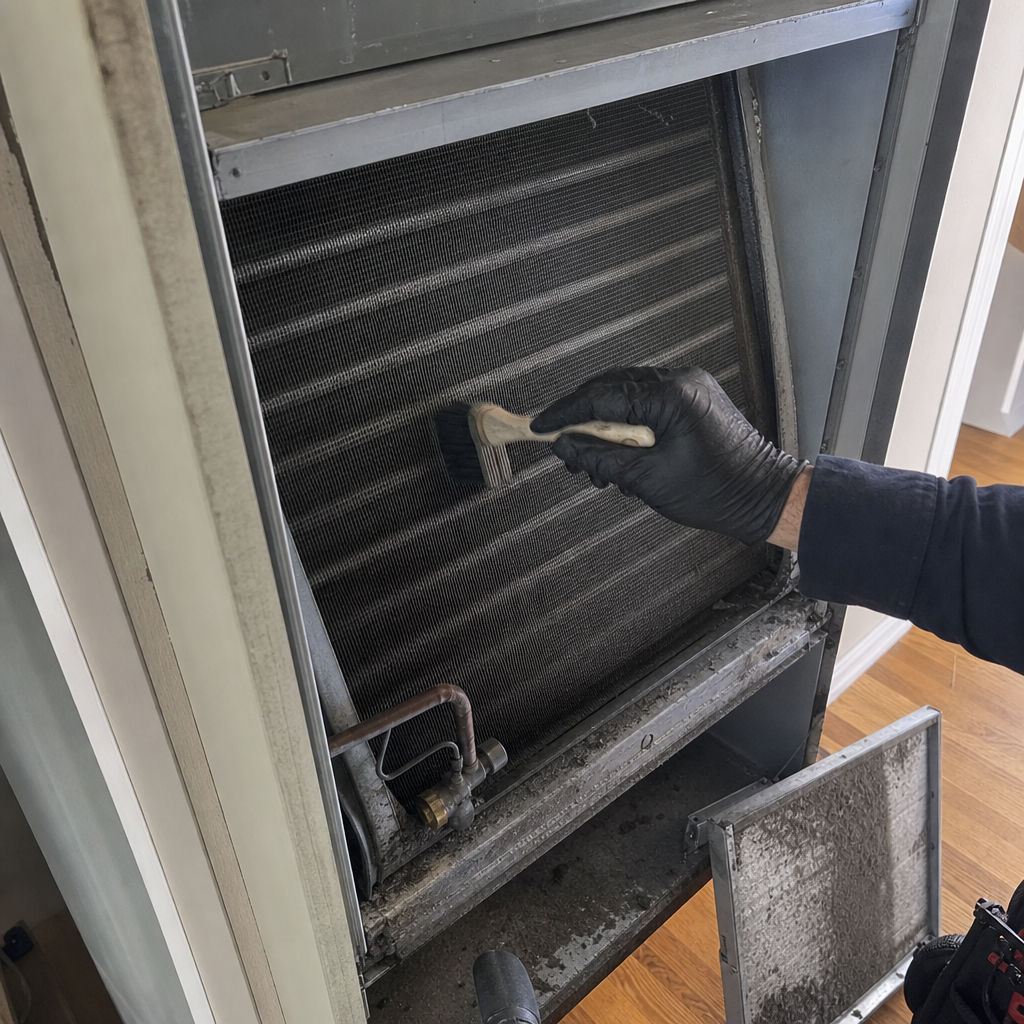
We evaluate sealing in context of the complete air pathway — from return grille to supply register, including the coil, blower, and filter housing. A leak on the return side pulls unfiltered attic or wall cavity air directly into your breathing stream; a supply leak wastes energy and creates moisture problems. Either can mask as an equipment problem. We’ve had Hartford homeowners quoted $3,000 for a new blower motor when the real issue was a collapsed return duct pulling restricted airflow.
Our equipment reflects that systems approach. We run professional-grade Rotobrush and Nikro equipment — the same tools commercial and industrial contractors rely on — not consumer-grade vacuums with branding stickers. For sealing diagnostics, we use calibrated duct blasters and digital manometers that quantify leakage in CFM at 25 Pascals, not guesswork. And because Steven leads every job personally, the analysis you get comes from 14 years of hands-on experience with Hartford’s specific housing stock, not a technician rotation where this month’s hire is learning on your system.
That continuity matters for sealing work especially. The same person who diagnosed your leakage pattern is the person who specifies the sealant method, executes the repair, and verifies the result with post-work pressure testing. No handoffs, no “the crew will handle it.” Our Duct Repair & Sealing service is built on that accountability.
We also work with the premium air quality brands already in many Hartford homes — Honeywell, Aprilaire, Abatement Technologies — so if your sealing project reveals compatibility issues or upgrade opportunities, we can advise accurately without bringing in a second contractor.
Key Takeaways: Duct Sealing Cost in Hartford
- Realistic sealing range: $800–$2,400 for most Hartford homes, with hybrid methods most common in retrofit housing
- Never accept a sealing quote without pressure-test diagnostics — visual inspection misses the leaks that matter in Hartford’s plaster-wall and chase-run systems
- Diagnostic cost ($150–$300) should be credited toward sealing work; if it’s not, you’re paying twice
- Summer humidity in the Connecticut River Valley makes sealing a mold-prevention measure, not just an efficiency play
- Sealing a degraded system is temporary; honest evaluation includes repair-or-replace guidance
FAQs
Most Hartford homeowners pay $800–$2,400 for Affordable Duct Repair & Sealing in Hartford, CT, depending on whether the work involves accessible mastic application or aerosol injection for hidden leaks. The exact figure requires a pressure-test diagnostic first — we won’t quote sealing without one. Call (844) 923-4376 for a free estimate that includes testing.
DIY mastic application at accessible joints costs $50–$150 in materials, but it won’t reach the hidden leaks that dominate Hartford retrofit systems — the ones behind plaster walls and inside closet chases. More critically, without pressure testing, you can’t know if you’ve solved the problem or just improved the symptoms. We’ve re-tested homeowner-sealed systems that still leaked 18–22% because the dominant paths were never found. For the diagnostic alone, professional evaluation pays for itself.
Most residential sealing jobs in Hartford run 4–8 hours: 1–2 hours for diagnostic and setup, 2–5 hours for sealing execution, and 30 minutes for post-work verification testing. Aerosol injection takes longer than mastic-only work due to system prep and cure time. We schedule to completion, not to a clock — Steven stays until the pressure test confirms the leakage reduction we promised.
Yes — a system leaking 20% or more typically saves $200–$400 annually on heating and cooling in Hartford’s climate, with payback in 3–5 years at current rates. But the more immediate benefit for most of our customers is humidity and mold control: sealed ducts stop dumping conditioned air into wall cavities where Connecticut River Valley summer humidity creates condensation and biological growth. Call (844) 923-4376 to test your system and calculate your specific savings potential.
Get a Free Estimate With Pressure Testing Included
Don’t guess at duct sealing cost — and don’t trust a quote that skips the diagnostic. At Empire Air Duct Cleaning Service Greater Hartford, we test every system before we price, seal what actually needs sealing, and verify results before we leave. Steven Ramirez handles every job personally, with 14 years of experience in Hartford’s specific retrofit housing stock and over 1,000 verified reviews backing our work. Call (844) 923-4376 today for your free estimate and pressure test.
Written by Steven Ramirez, Owner & Lead Technician at Empire Air Duct Cleaning Service Greater Hartford, serving Hartford, CT.
What Our Customers Say
"Job was done well and the house smells better. There was some dust knocked loose around a couple of the registers that I had to wipe down afterward."
— Rana Karam"Quoted per system rather than the bait and switch per vent pricing everybody else in town uses. The number I was told on the phone was the number on the invoice."
— Destiny Coleman"They photographed every return and supply before starting and sent me the file afterward. No upsell to a sanitizing treatment I didn't need."
— Miguel Hernandez