
Last updated July 11, 2026
How to Hire a Air Duct Cleaning Contractor in Hartford: A Step-by-Step Guide
That $89 coupon in your mailbox? It’s not a deal — it’s a selection filter for homeowners who won’t ask hard questions. In our 14 years working across Hartford, from the historic homes of West End to the newer construction in Blue Hills, we’ve seen the aftermath: ducts still packed with debris, access panels left open, and homeowners who paid twice because the first crew disappeared after an hour. The Hartford market has a specific contractor problem — legitimate HVAC companies that treat duct cleaning as a low-priority add-on, and low-cost crews with truck-mount blowers but no real negative-pressure containment. This guide teaches you to tell the difference before anyone shows up at your door.
Quick Answer
Hiring a qualified air duct cleaning contractor in Hartford means verifying three things before you book: professional-grade negative-pressure equipment (Rotobrush or Nikro systems, not shop vacuums), who physically performs the work (the owner or a rotating crew), and whether the estimate includes a pre-cleaning video inspection with line-item pricing. Avoid any contractor who won’t commit to all three in writing.
Table of Contents
- Why the Hartford Market Makes This Harder Than It Should Be
- The Three Questions That Separate Specialists From Dispatch Crews
- What Equipment Actually Matters (And What Doesn’t)
- NADCA Certification: What It Means and What It Doesn’t
- How to Read a Duct Cleaning Estimate Like a Technician
- Connecticut Licensing: What State Registration Actually Covers
- How to Verify Reviews Are Real and Job-Specific
- Common Mistakes to Avoid
- When to Call a Professional
- Frequently Asked Questions
- The Bottom Line
Why the Hartford Market Makes This Harder Than It Should Be
Hartford’s housing stock creates a perfect storm for duct cleaning confusion. We’ve got everything from 1920s Colonials with original plaster and updated forced-air systems, to 1960s ranch homes with decades of accumulated debris, to new construction in neighborhoods like Sheldon-Charter Oak where builders’ dust still circulates through fresh ductwork. Each requires a different approach, but most contractors apply one method to every job.
The market splits into three categories, and only one serves homeowners well:
- HVAC generalists who install and repair heating and cooling systems, but treat duct cleaning as an afterthought — often using portable vacuums without proper agitation or containment
- Low-cost coupon crews who operate on volume, not quality, typically spending 45 minutes to an hour per job before moving to the next appointment
- Owner-operated specialists who focus specifically on air quality systems, invest in proper equipment, and stake their personal reputation on every job
Hartford’s climate compounds the issue. Our humid summers and cold winters mean ducts here deal with moisture cycling that southern or western climates don’t experience. We’ve pulled substantial mold growth from systems in West Hartford homes that were “cleaned” six months prior by crews who never checked for moisture intrusion. The seasonal temperature swings also mean Hartford homeowners run their HVAC systems harder and longer than many other markets — more runtime equals more debris accumulation, and more reason to demand thorough cleaning.
The Empire Air Duct Cleaning Service Greater Hartford home page details how we’ve built our approach specifically for this region’s conditions. But whether you choose us or another contractor, understanding these market dynamics helps you ask better questions from the start.
The Three Questions That Separate Specialists From Dispatch Crews
Before you book any contractor, ask these three questions. Their answers will tell you everything about what actually shows up at your door.
Question 1: What specific equipment do you use for agitation and vacuum collection?
Serious contractors name brands and models. Vague answers like “professional truck-mounted system” or “industrial-strength equipment” signal either ignorance or intentional obscurity. You want to hear specific names: Rotobrush for brush-and-vacuum contact cleaning, Nikro for negative-pressure HEPA containment systems. These are the tools commercial and industrial contractors rely on, and they’re what residential jobs in Hartford actually need.
Here’s what the answer reveals:
| What They Say | What It Usually Means |
|---|---|
| “We use Rotobrush and Nikro systems” | Specialist who invested in proper equipment |
| “Truck-mounted vacuum with high CFM” | May lack proper agitation tools for contact cleaning |
| “Professional-grade equipment” | Generic claim, often consumer-grade tools |
| “Shop vacuum with attachments” | Not adequate for contained duct cleaning |
Question 2: Who physically performs the work — the owner, employees, or subcontractors?
This is where Hartford’s market gets interesting. Many “companies” are actually lead-generation operations that sell your appointment to the lowest-bidding subcontractor. The person who answers your call, the person who gives your estimate, and the person who shows up may be three different people with no accountability chain.
Steven Ramirez leads every job personally at Empire Air Duct Cleaning. That’s not a marketing line — it’s a structural difference. When the owner is on-site, quality control happens in real time, not through a callback survey after a crew has already moved to the next town. In 14 years, we’ve never had a homeowner tell us they preferred dealing with a dispatcher over direct communication with the technician doing the work.
Question 3: What does your inspection process include before and after cleaning?
A legitimate contractor inspects before quoting and documents after completing. Pre-cleaning inspection should include access point identification, video or photo documentation of debris load, and moisture checks. Post-cleaning should show the same access points, demonstrate debris removal, and verify system integrity.
Contractors who quote flat rates over the phone without inspection are guessing — or planning to upsell once they’re in your home. Either way, you’re not getting an honest assessment.
What Equipment Actually Matters (And What Doesn’t)
Equipment discussions get technical fast, but homeowners need only understand a few key distinctions. The goal of duct cleaning is debris removal without redistribution — pulling contaminants out of your system, not pushing them into your living space.
Negative pressure containment is non-negotiable. This means the vacuum system creates suction throughout the ductwork so dislodged debris travels directly to collection, not through your vents. Nikro systems are specifically designed for this containment protocol.
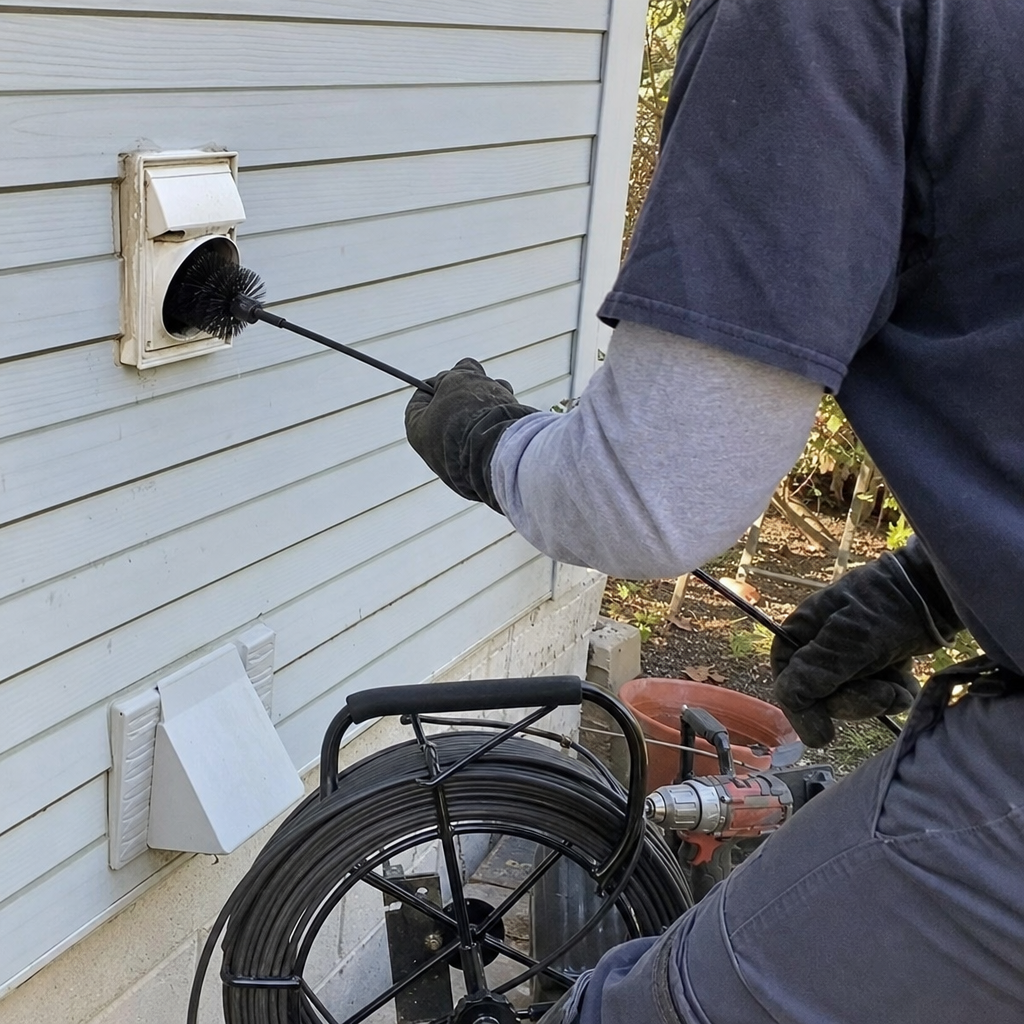
Mechanical agitation is what actually dislodges debris. Compressed air alone, or “skipper balls” that bounce through ducts, doesn’t contact surfaces thoroughly. Rotobrush systems use rotating brushes that physically scrub duct walls while simultaneous vacuum collection captures the debris.
HEPA filtration on the collection side prevents fine particles from exhausting back into your home or the contractor’s workspace. This matters particularly in Hartford’s older homes, where decades of accumulated dust may contain lead, asbestos, or other hazardous materials from prior renovations.
What doesn’t matter: ozone generators (banned for indoor air use in some states, ineffective for debris removal), chemical “foggers” without mechanical cleaning (deodorants, not cleaners), or UV light installation without cleaning first (light doesn’t remove existing buildup).
We’ve worked with premium air-quality equipment from Honeywell, Aprilaire, and Abatement Technologies across Hartford homes — not because we sell these brands, but because understanding their integration with duct systems matters for proper cleaning protocol. A contractor who can’t discuss how their process protects your existing equipment isn’t thinking systematically.
NADCA Certification: What It Means and What It Doesn’t
The National Air Duct Cleaners Association (NADCA) sets standards for the industry, and certification indicates a contractor has completed training and adheres to specific cleaning protocols. It’s a useful baseline — but in Hartford’s owner-operator market, it’s not the complete picture.
NADCA certification applies to companies and individual technicians. A company can be certified while sending uncertified subcontractors to your home. Certification also doesn’t specify equipment requirements beyond general performance standards, meaning a certified contractor could theoretically use inadequate tools and still comply.
More importantly, NADCA certification doesn’t guarantee the owner shows up. We’ve encountered NADCA-certified operations in Greater Hartford where the certified owner manages from an office while minimum-wage crews handle fieldwork. The certification is real; the accountability chain is broken.
Our recommendation: ask about NADCA certification, but treat it as a starting point, not a deciding factor. Pair it with our three questions above. A contractor who is both certified and able to detail their specific equipment, personnel, and inspection process is likely legitimate. One who leads with certification but deflects on specifics is using it as a shield.
For Hartford homeowners specifically, the Air Duct Cleaning in Manchester market shows similar patterns — certification density without proportional quality consistency. The same evaluation framework applies across the region.
How to Read a Duct Cleaning Estimate Like a Technician
Estimates reveal contractor intent. Detailed line-item proposals indicate transparency; vague single-line quotes invite surprises. Here’s what should appear on any legitimate Hartford duct cleaning estimate:
- System size and access point count — number of supply and return vents, main trunk lines, and any difficult-access areas
- Pre-cleaning inspection — visual and/or video documentation of system condition
- Cleaning method specification — equipment to be used, containment protocol, and filtration standard
- Component scope — registers, grilles, ductwork, plenum, and whether the HVAC unit itself is included
- Post-cleaning verification — how results will be demonstrated and documented
- Exclusions and options — what’s not included (duct repair, sealing, sanitizing) and available add-ons with separate pricing
Red flags in estimate language:
- “Whole house special” without vent count — scope undefined, upsell likely
- “Up to X vents” — you’ll pay extra for anything beyond, often at inflated rates
- “Free sanitizing included” — sanitizing without proper cleaning is ineffective; this signals either ignorance or deception
- “HVAC cleaning” without specifying components — may mean only the ductwork, or may ambiguously suggest the full system
In Hartford’s market, legitimate whole-system cleaning for an average three-bedroom home typically ranges from $400–$700 depending on accessibility and contamination level. The $89–$149 offers universally indicate either severe scope limitation or bait-and-switch tactics. We’ve been called to homes in Barry Square and Behind the Rocks where the “complete” $99 cleaning lasted 35 minutes and left visible debris.
Connecticut Licensing: What State Registration Actually Covers
Connecticut’s licensing structure creates genuine confusion for homeowners. Here’s what you need to understand:
HVAC contractor licensing (through the Connecticut Department of Consumer Protection) covers mechanical work on heating, ventilation, and air conditioning systems — installing furnaces, modifying ductwork, refrigerant handling. It does not specifically address cleaning protocols or equipment standards.
Duct cleaning as a standalone service falls into a regulatory gap. No Connecticut-specific license certifies duct cleaning expertise. Contractors may operate under general business registration, home improvement contractor registration, or HVAC licensure depending on their broader service scope.
This means “licensed and insured” claims require follow-up questions. Licensed for what, exactly? Insured for what activities? A contractor properly insured for HVAC installation may have gaps in coverage for duct-specific work, particularly contamination liability.
For Hartford homeowners, this regulatory ambiguity makes the three questions even more critical. Without state-mandated standards, contractor quality depends entirely on self-imposed standards — equipment investment, training commitment, and personal accountability. We’ve maintained our protocols above minimum requirements because the minimum, frankly, doesn’t protect homeowners adequately.
The HVAC Cleaning in Manchester page details how we handle mechanical system cleaning specifically, which intersects with but differs from duct cleaning alone. Understanding this distinction helps you request the right service scope.
How to Verify Reviews Are Real and Job-Specific
With 1,074 verified reviews averaging 4.9 stars, we’ve learned what authentic feedback looks like — and how to spot the manufactured kind. Hartford homeowners should scrutinize reviews before booking, especially for contractors with high volume but suspicious patterns.
Signs of legitimate reviews:
- Specific location mentions — “our home in West Hartford,” “the condo in Downtown”
- Technical details — “they found a disconnected return in the basement,” “showed us the before video of the main trunk”
- Timeline specifics — “booked Tuesday, came Thursday,” “took about four hours for our 2,200 square foot house”
- Varied ratings with substantive criticism — even good businesses have occasional 3-4 star reviews with specific, reasonable concerns
Red flags in review patterns:
- Clusters of 5-star reviews posted within short timeframes, especially without verified purchase markers
- Generic language repeated across multiple reviews — “great service,” “very professional,” “highly recommend” with no specifics
- Reviews for unrelated services mixed with duct cleaning feedback — the same reviewer praising plumbing, roofing, and duct work from one company suggests review farming
- Owner responses that are defensive or generic rather than addressing specific concerns
Cross-reference platforms. A contractor with 200 Google reviews but none on Yelp, BBB, or industry-specific sites may be selectively curating. We’ve found that genuine customer satisfaction shows across platforms, not just where it’s easiest to control.
For property managers and repeat customers, ask for references from similar jobs — same building type, comparable system age, equivalent scope. A contractor serving Hartford’s apartment conversions in Frog Hollow should be able to discuss specific challenges those buildings present.
Common Mistakes to Avoid
- Booking based on price alone. The $89 coupon crew in Hartford typically spends under an hour, uses inadequate equipment, and leaves systems partially cleaned. We’ve re-cleaned dozens of these jobs, and homeowners always pay more total than if they’d hired properly initially.
- Assuming HVAC companies automatically do quality duct work. Many excellent Hartford HVAC contractors install superior equipment but subcontract duct cleaning to low-bid crews, or use portable vacuums without proper containment. Ask specifically about their duct process, not their reputation for furnace installation.
- Neglecting dryer vent inspection. Clogged dryer vents cause thousands of house fires annually, and Hartford’s older housing stock with longer vent runs faces elevated risk. The Dryer Vent Cleaning in Manchester service page explains our approach, but any duct contractor should address this component or explain why it’s excluded.
- Accepting phone quotes without inspection. Duct configuration varies enormously — we’ve seen identical square-footage homes in Hartford with 8 vents versus 18 vents, original metal ductwork versus flexible duct additions, accessible basements versus crawl space nightmares. Flat rates without visual assessment guarantee either overpayment (for simple jobs) or corner-cutting (for complex ones).
- Ignoring post-cleaning documentation. Without before/after evidence, you have no verification of work quality. We provide video documentation as standard practice; any contractor resisting this transparency has something to hide.
- Delaying after visible mold or pest evidence. Hartford’s humidity and mature tree canopy create conditions for both. Waiting for “convenient timing” allows contamination to spread. These scenarios require immediate professional assessment, not coupon-book shopping.
- Failing to verify who’s actually coming. “Our technician will arrive” means nothing. Get a name, and confirm it’s the person you’ve researched. When Steven Ramirez schedules your job, Steven Ramirez performs your job — no substitutions, no surprises.
When to Call a Professional
Call for assessment when you notice persistent dust accumulation shortly after cleaning, musty odors when HVAC runs, visible mold near vents, or increased allergy symptoms indoors. After any renovation — particularly in Hartford’s historic homes where plaster work and sanding generate fine particulate — duct inspection is warranted before system restart.
Property managers in multi-unit buildings should schedule annual inspection, as shared duct systems compound contamination spread. Post-fire or flood recovery always requires professional duct assessment, as smoke and moisture intrusion create hazards invisible from vent openings.
Empire Air Duct Cleaning Service Greater Hartford offers free estimates in Hartford — call (844) 923-4376. Steven Ramirez will inspect your system personally, explain findings without pressure, and provide line-item pricing you can compare against any other contractor. No coupons, no bait-and-switch, just 14 years of owner-operated accountability.
Frequently Asked Questions
Whole-system duct cleaning for an average Hartford home typically runs $400–$700 depending on vent count, accessibility, and contamination level. Older homes in neighborhoods like West End or Asylum Hill often require additional time due to complex duct routing and plaster debris. Call (844) 923-4376 for a free, no-obligation estimate based on your specific system — we provide exact pricing after inspection, not vague ranges over the phone.
Every 3–5 years for typical residential systems, with shorter intervals for homes with pets, smokers, recent renovations, or residents with respiratory conditions. Hartford’s seasonal humidity and older housing stock often accelerate accumulation, so we recommend inspection every 2–3 years even without visible symptoms. Our 14 years of service here shows that proactive maintenance prevents the costly remediation that deferred cleaning eventually requires.
No — Connecticut does not mandate NADCA certification or any specific duct cleaning credential. This regulatory gap makes contractor evaluation entirely the homeowner’s responsibility, which is why equipment verification and owner accountability matter more than certificates on a wall. We exceed NADCA standards in our processes, but we emphasize direct verification over credential display.
Moderately, yes — clean ducts reduce airflow resistance, allowing your HVAC system to work less hard, particularly during Hartford’s extreme summer humidity and winter cold. However, energy savings are typically secondary to air quality benefits. The greatest efficiency gains come when cleaning is paired with duct sealing, which we assess during every inspection.
Duct cleaning addresses the distribution network — supply and return vents, trunk lines, and plenums. HVAC cleaning includes the mechanical components: blower motor, evaporator coils, heat exchanger, and condensate pan. For complete system health, both are necessary, and we offer full-system service under one provider. The HVAC Cleaning in Manchester page details mechanical component protocols.
Ask specifically about negative-pressure containment and mechanical agitation tools. Legitimate contractors name brands like Rotobrush or Nikro and explain their containment protocol. Request to see equipment before work begins — a shop vacuum with duct attachments is inadequate. In our experience, contractors who hesitate to show and explain their tools are relying on tools they know won’t withstand scrutiny.
The Bottom Line
Hiring a duct cleaning contractor in Hartford requires looking past surface credentials to operational specifics. The market’s mix of HVAC generalists, coupon crews, and genuine specialists means homeowners must verify equipment, personnel, and process before committing. The three questions — what equipment, who performs the work, what’s the inspection protocol — cut through marketing to reveal actual capability. Price alone selects for the wrong contractor; specificity and accountability select for the right one. In 14 years serving Hartford, we’ve built our reputation on transparency that survives these questions, not on offers designed to avoid them.
Written by Steven Ramirez, Owner & Lead Technician at Empire Air Duct Cleaning Service Greater Hartford, serving Hartford since 2012.