
Last updated September 3, 2026
The Complete Guide to Air Duct Cleaning in Hartford
After inspecting over a thousand duct systems across Greater Hartford, the most common finding isn’t what homeowners call about — it’s what they never noticed. In West Hartford colonials built in the 1950s, we’ve pulled out fiberglass duct liner that had turned to powder. In East Hartford ranches with original oil-to-gas conversions, we’ve found soot residue coating every branch line that residents assumed was “just dust.” Hartford’s housing stock tells a story that national duct-cleaning guides miss entirely. This guide draws the line between myth and reality using what 14 years of opening actual duct systems in Connecticut homes reveals — not what the industry average recommends — and points to more guides & resources for ongoing maintenance.
Quick Answer
Professional air duct cleaning in Hartford typically costs $300–$700 for a standard single-family home and takes 3–5 hours using negative-pressure extraction. Most Hartford homeowners benefit from cleaning every 3–5 years, though homes with pre-1990 construction, oil-to-gas heating conversions, or finished basements with exposed ductwork often need more frequent attention due to Connecticut’s freeze-thaw climate and older housing-specific contamination patterns.
Table of Contents
- How Hartford’s Climate and Housing Stock Affect Your Ducts
- Surface Dust vs. Deep System Contamination: Know the Difference
- What Legitimate Negative-Pressure Cleaning Actually Looks Like
- Hartford-Specific Red Flags: Oil Conversions, Fiberglass Decay, and More
- How to Read Your Own System After a Cleaning
- What Air Duct Cleaning Costs in Hartford
- Common Mistakes to Avoid
- When to Call a Professional
- Frequently Asked Questions
How Hartford’s Climate and Housing Stock Affect Your Ducts
Hartford’s continental climate — humid summers, freeze-thaw winters, and shoulder seasons that swing 40 degrees in a week — creates duct contamination patterns you won’t find in Phoenix or San Diego. We’ve learned this from 14 years of pulling debris from systems in neighborhoods from Blue Hills to South End.
Here’s what makes Hartford different:
- Freeze-thaw cycling cracks foundations and seals. Every winter, soil expansion and contraction around Hartford’s older basements shifts concrete, opens rim joist gaps, and creates new pathways for crawlspace moisture and particulate to enter return ducts. We’ve found construction debris from 1960s builds still migrating into living spaces because of these seasonal pathways.
- Pre-1990 construction dominates the market. Roughly 60% of Hartford’s housing stock predates modern duct standards. Original galvanized steel ducts in West End Victorians and 1970s ranch-style homes in North East haven’t seen the material upgrades that became common after 1990. That means more rust particulate, more joint separation, and more opportunities for fiberglass liner degradation.
- Basement humidity swings drive microbial growth. Hartford’s average basement relative humidity hits 65–75% in summer months. When that moist air meets the temperature differential of ductwork running through unconditioned basement space, condensation forms on exterior duct surfaces and wicks into insulation. We’ve opened systems in Parkville where the interior looked clean — but the exterior wrap was harboring mold that eventually colonized the supply air.
- Leaf litter and urban particulate matter. Hartford’s mature tree canopy is beautiful, but decomposing leaf matter produces fine particulate that finds its way into outdoor air intakes. Combine that with I-84 corridor traffic residue, and you’re looking at a particulate load that suburban guides underestimate.
In our experience, Hartford homeowners who follow national “every 3–5 years” advice without accounting for these local factors often wait too long — or clean too early, before the system has actually accumulated problematic debris.
Surface Dust vs. Deep System Contamination: Know the Difference
Not everything that looks dirty needs professional cleaning. This distinction saves Hartford homeowners hundreds of dollars and prevents unnecessary service calls.
Surface dust is what you see when you remove a floor register: a gray film, maybe some lint, perhaps pet hair. It’s unsightly, but it’s not circulating through your HVAC system in meaningful quantities. A vacuum with a brush attachment handles this. We’ve had homeowners in Elmwood call us in a panic over register dust that took five minutes to address themselves.
Deep system contamination is what accumulates in the trunk lines, branch ducts, and plenum — the areas you cannot see without specialized access. This is where we find:
- Compacted debris layers — dust, skin cells, and particulate that have adhered to duct walls through humidity cycling and electrostatic attraction. In Hartford’s older homes, these layers can reach 1/4-inch thickness and actually reduce effective duct diameter.
- Microbial growth on fiberglass liner — visible as dark spotting or musty odor when the system first kicks on. This requires more than cleaning; it requires assessment of whether the liner itself is failing.
- Soot and combustion residue — particularly in homes with oil-to-gas conversion histories, where the original oil burner may have produced incomplete combustion that coated duct interiors before the switch.
- Construction debris from prior renovations — drywall dust, insulation fragments, and sawdust that contractors failed to seal out. In Hartford’s active renovation market, we’ve found systems contaminated from kitchen remodels done 15 years prior.
The test we recommend: remove a register and shine a flashlight into the duct. If you see clean metal walls 2–3 feet in, you’re likely dealing with surface dust. If you see uniform gray coating, debris buildup at joints, or any dark spotting, that’s deep contamination requiring professional equipment.
Our Empire Air Duct Cleaning Service Greater Hartford home page details how we assess this distinction before recommending any service.
What Legitimate Negative-Pressure Cleaning Actually Looks Like
The duct cleaning industry has a reputation problem, and Hartford isn’t immune. We’ve been called in after “$99 whole-house specials” that left systems worse than when they started. Here’s how to hire a air duct cleaning contractor in Hartford: a step-by-step guide to telling legitimate negative-pressure cleaning from the “blow and go” method that low-bid crews deploy.
Legitimate negative-pressure cleaning follows this sequence:
- System inspection and access creation. We cut sealed access points into the trunk line — typically 8–10 inches — to insert visual inspection tools and cleaning attachments. This isn’t optional; if a crew claims they can clean through registers alone, they’re not reaching your trunk lines.
- Negative-pressure source connection. Our Nikro HEPA-filtered collection unit attaches to the duct system, creating sustained suction of 2,000–3,500 CFM. This is the “negative pressure” — it ensures dislodged debris moves toward collection, not into your living space.
- Mechanical agitation of duct walls. We use Rotobrush contact cleaning systems with powered brushes sized to duct diameter. The brushes physically dislodge adhered debris while the negative pressure immediately captures it. Compressed air whips and skipper balls have their place for straight metal ducts, but they don’t contact-clean fiberglass-lined systems effectively.
- Branch-by-branch isolation and cleaning. Each supply and return branch gets individual attention, with temporary blockers preventing cross-contamination. A “blow and go” crew skips this, running a single tool down the trunk and calling it done.
- Post-cleaning verification. We re-inspect through access points to confirm debris removal. In Hartford’s older systems, we sometimes find areas requiring additional attention — a joint that separated, a liner section that degraded during cleaning.
The “blow and go” alternative? A shop vacuum with a long hose, or compressed air blown through registers without containment. We’ve found these methods simply redistribute debris into the living space, or push it deeper into the system where it becomes harder to address later.
Professional-grade Rotobrush and Nikro equipment isn’t a luxury in Hartford’s housing stock — it’s a necessity for systems with decades of accumulated contamination, joint separation, and mixed duct materials.
Hartford-Specific Red Flags: Oil Conversions, Fiberglass Decay, and More
Fourteen years in Hartford has taught us to look for contamination signatures that national certification courses don’t cover. When Steven leads every job personally, these are the patterns he watches for:
Oil-to-gas conversion residue. Hartford’s push away from oil heating in the 1980s and 1990s left thousands of homes with duct systems coated in oily soot. The combustion byproducts from older oil burners — particularly those with poor maintenance histories — created a sticky, black residue that standard dust doesn’t describe. We’ve opened systems in Barry Square where the interior walls were uniformly black, and homeowners had no idea because the previous owner completed the conversion in 1992. This residue requires solvent-based cleaning agents and extended contact time that consumer methods cannot provide.
Fiberglass duct liner deterioration. Pre-1980 construction in Hartford frequently used fiberglass-lined ductwork for acoustic dampening. After 40+ years of humidity cycling, this liner becomes friable — it crumbles to the touch and releases fibers into the airstream. In West Hartford ranches built in the 1960s and 1970s, we’ve found liner sections that have completely detached and collapsed into the duct bottom, creating airflow restrictions and fiber contamination simultaneously. Cleaning these systems requires gentler agitation and sometimes liner repair or replacement recommendations.
Asbestos tape at duct joints. Hartford’s building boom decades (1920s–1960s) used asbestos-containing tape to seal duct joints. Disturbing this material during aggressive cleaning creates serious exposure risk. We visually identify suspect tape before any mechanical agitation begins, and we halt work if asbestos abatement is indicated. This is why owner-on-site accountability matters — a rotating crew might not recognize what they’re looking at.
Finished basement duct exposure. Hartford homeowners love finished basements, but exposed ductwork in these spaces becomes a visual and air-quality liability. We’ve found supply runs in Farmington Valley-area homes where the homeowner painted over rust and dust accumulation rather than addressing the underlying moisture issue. The painted surface looks clean; the interior continues deteriorating.
Chimney flue misconnections. In older Hartford multifamily conversions, we’ve encountered DIY modifications where exhaust flues were incorrectly tied into duct systems — a genuine carbon monoxide hazard that duct cleaning reveals. This isn’t common, but 14 years of opening systems has taught us that “unusual” in Hartford’s housing stock happens often enough to check every time.
How to Read Your Own System After a Cleaning
You’ve paid for professional cleaning. Here’s how to verify you received what you paid for — and what “clean” actually means in Hartford’s specific context.
Visual inspection through access points. Legitimate cleaners leave access points that allow future inspection. Shine a flashlight in: clean metal should appear uniformly dull-gray, not shiny (that suggests aggressive brushing that may have damaged surfaces) and not coated. In fiberglass-lined systems, the liner should appear intact, with original yellow or white color visible, not gray or black.
Odor assessment at system startup. The first 2–3 heating or cooling cycles after cleaning should produce neutral-smelling air. A musty odor suggests remaining moisture or microbial growth. A chemical odor suggests excessive cleaning agent use. A dusty odor suggests debris was dislodged but not fully extracted. In Hartford’s humid summers, we specifically check that basement humidity sources have been addressed — otherwise, new microbial growth begins within weeks.
Airflow at distant registers. Clean ducts with sealed joints deliver more consistent airflow. Check the register farthest from your furnace — if airflow improved noticeably, the cleaning likely removed significant obstruction. No change suggests either the system wasn’t dirty to begin with, or the cleaning failed to address trunk-line restrictions.
Filter loading in the first month. A properly cleaned system should show normal filter loading — gradual gray accumulation over 30–60 days depending on your filter type. Rapid filter blackening in the first two weeks suggests remaining debris is still migrating, or that the cleaning disturbed debris without extracting it fully.
Debris in the collection unit. We show Hartford homeowners what we extracted. It’s not pleasant, but it’s proof. A “cleaning” that produces a cup of debris from a 2,000-square-foot home didn’t reach the system. We typically extract 5–15 pounds from systems that haven’t been cleaned in 5+ years — more if oil residue or construction debris is present.
What Air Duct Cleaning Costs in Hartford
Pricing transparency matters. Here’s what professional duct cleaning costs in the Hartford market, based on system size and condition — not bait-and-switch estimates that triple on arrival.
| Home Size / System Type | Typical Range | Factors That Increase Cost |
|---|---|---|
| Small home (1,000–1,500 sq ft), single system | $300–$450 | Excessive debris, oil residue, difficult access |
| Mid-size home (1,500–2,500 sq ft), single system | $400–$600 | Finished basement access, multiple trunk lines |
| Large home (2,500–4,000 sq ft), single or dual system | $550–$800 | Zoned systems, extensive fiberglass liner |
| Multifamily / duplex (per unit) | $350–$500 | Shared ductwork, code compliance requirements |
| HVAC cleaning (coils, blower, cabinet) | $200–$350 add-on | Heavy coil fouling, rusted components |
| Duct repair & sealing (per linear foot) | $15–$35 | Access difficulty, mastic vs. tape methods |
What drives Hartford-specific pricing variation:
- Access difficulty. Crawlspace systems in older East Hartford homes take longer than basement systems with full headroom.
- Contamination type. Oil residue and construction debris require extended contact time and specialized cleaning agents — not just mechanical agitation.
- System condition. Ducts with separated joints or failed liner need repair before effective cleaning is possible. We identify this during pre-cleaning inspection and quote accordingly — never mid-job.
- Legitimate add-ons. Sanitizing with EPA-registered products, dryer vent cleaning, and HVAC component cleaning are valid additional services when the condition warrants. They’re upsells only when recommended without inspection basis.
Our Air Duct Cleaning in Manchester page shows how pricing compares across the Greater Hartford market.
Common Mistakes to Avoid
- Booking based on coupon price alone. The $99 whole-house special in Hartford inevitably becomes $600+ on arrival, or leaves your system improperly cleaned. We’ve re-cleaned after these services more times than we can count — homeowners pay twice.
- Ignoring the HVAC components. Cleaning ducts without addressing the blower, evaporator coil, and plenum is like mopping around a muddy boot. The system recirculates contamination immediately. Full-system air quality means addressing all components, not just the distribution network.
- Assuming new construction is clean. We’ve found drywall dust, insulation fragments, and even fast-food wrappers in ducts of homes built in 2020. Hartford-area builders’ cleanup standards vary dramatically — new doesn’t mean clean.
- DIY register cleaning as “duct cleaning.” Vacuuming visible register dust improves appearance but doesn’t address trunk-line accumulation. Homeowners in West Hartford’s historic district particularly underestimate how much debris hides in inaccessible runs.
- Waiting for visible mold before acting. By the time mold is visible at registers, it’s established throughout the system. Musty odor at startup — especially in Hartford’s humid July and August — is the earlier signal most homeowners miss.
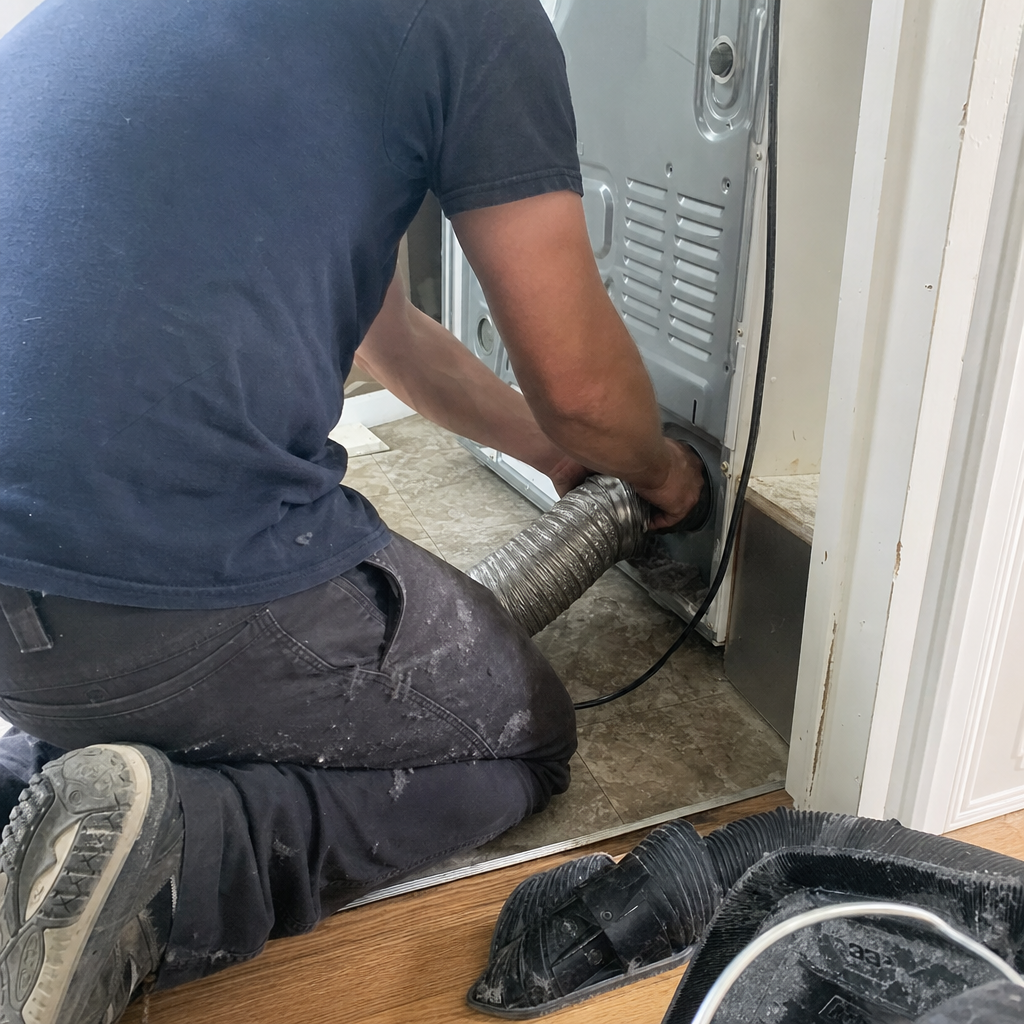
- Neglecting dryer vent cleaning. Lint accumulation in dryer vents is the leading cause of residential fires in Connecticut. Our Dryer Vent Cleaning in Manchester page details how this service integrates with full-system maintenance.
- Choosing crew-rotation companies over owner-operated service. The technician who quotes your job should understand what they found — not hand you off to a different person with a different standard. Steven leads every job personally because accountability can’t be delegated.
When to Call a Professional
Call for inspection — not necessarily cleaning — when you notice any of the following: persistent musty odor at system startup, visible debris blowing from registers, uneven heating or cooling across rooms, recent renovation with drywall or flooring work, or any home with oil-to-gas conversion history and unknown duct condition. In Hartford’s market, proactive inspection beats reactive emergency service.
Empire Air Duct Cleaning Service Greater Hartford offers free estimates in Hartford — call (844) 923-4376. Steven Ramirez personally assesses every system, explains what he finds, and recommends only what’s warranted. No crew rotation, no commission pressure, 14 years, one standard.
Frequently Asked Questions
Professional air duct cleaning in Hartford typically ranges from $300 for smaller homes to $700–$800 for larger or more complex systems. Oil residue, extensive fiberglass liner degradation, or finished-basement access challenges can push costs toward the higher end. Call (844) 923-4376 for a free, exact quote based on your specific system — estimates are free and carry no obligation.
Most Hartford homes need professional cleaning every 3–5 years, but pre-1990 construction, oil-to-gas conversion history, or finished basements with humidity issues often warrant 2–3 year intervals; see our seasonal air duct cleaning care for Hartford: year-round homeowner’s guide for timing details. The freeze-thaw climate and older housing stock here create faster accumulation than national averages assume. We assess interval recommendations based on what we find in your specific system, not a calendar template.
Cleaning removes accumulated allergen reservoirs — dust mite debris, pollen, pet dander, and mold spores — that circulate through the HVAC system. In Hartford’s pollen-heavy spring and fall, this reduction can meaningfully decrease indoor allergen load. However, cleaning alone doesn’t address source issues like humidity control or pet access; we discuss integrated approaches when allergy concerns are primary.
Air duct cleaning addresses the distribution network — trunk lines, branches, and registers. HVAC cleaning addresses the air handler itself: blower assembly, evaporator coil, heat exchanger, and plenum. Cleaning ducts without cleaning the HVAC components allows immediate recontamination. Our HVAC Cleaning in Manchester page explains how we approach full-system service.
No. Compressed air without negative-pressure containment simply redistributes debris into your living space or deeper into the system. Legitimate cleaning requires HEPA-filtered collection, mechanical agitation, and branch-by-branch isolation. The low price reflects the low effort, not a bargain.
Check your basement utility area for a capped oil line, old oil tank remnants, or burner marks on the foundation wall. If your home converted before you owned it, the duct interior may still carry sticky black soot that standard dusting won’t remove. We identify this signature during inspection and adjust our cleaning protocol accordingly — it’s one of the most common surprises in Hartford’s older neighborhoods.
The Bottom Line
Hartford’s climate and housing stock demand a localized approach to duct cleaning that national guides cannot provide. Freeze-thaw cycling, pre-1990 construction dominance, oil-to-gas conversion history, and basement humidity patterns create contamination signatures we’ve learned to read over 14 years of hands-on work. The question isn’t whether duct cleaning matters — it’s whether your specific system, at this specific time, needs professional intervention versus maintenance you can handle yourself. Surface dust is yours; deep system contamination, oil residue, fiberglass degradation, and microbial growth require professional-grade equipment and owner-accountable expertise. Start with honest inspection, expect transparent pricing, and verify results through access-point inspection and system performance — not just a receipt — following an air duct cleaning maintenance checklist for Hartford homeowners.
Ready to know what your Hartford system actually contains? Call Empire Air Duct Cleaning Service Greater Hartford at (844) 923-4376 for a free estimate. Steven Ramirez personally inspects every system, and you’ll speak with the same person who does the work — not a dispatcher, not a sales closer.
Written by Steven Ramirez, Owner & Lead Technician at Empire Air Duct Cleaning Service Greater Hartford, serving Hartford since 2012.