
Last updated September 3, 2026
Air Duct Cleaning Maintenance Checklist for Hartford Homeowners
Here’s the pattern we see across Hartford homes from Empire Air Duct Cleaning Service Greater Hartford home: the single most skipped item on every homeowner’s HVAC maintenance list is also the one that makes every other maintenance task less effective. You change your filter religiously, you schedule annual furnace tune-ups, yet the ductwork itself — the distribution system that carries every heated and cooled breath through your home — goes untouched for years. In our 14 years working in Hartford, we’ve opened systems in West Hartford colonials and Manchester split-levels where the ducts hadn’t been inspected since the Clinton administration. This checklist reflects the actual maintenance gaps Steven Ramirez finds repeatedly, not a generic printout from a manufacturer.
Quick Answer
A proper air duct maintenance checklist for Hartford homeowners includes quarterly filter checks timed to pollen seasons, annual visual inspections of registers and return vents for debris buildup, biannual attic/crawlspace flex-duct checks for disconnections or crushing, and our Air Duct Cleaning services every 3–5 years using Rotobrush or Nikro-grade equipment. Document airflow and odor baselines after each professional cleaning so you have measurable comparison points for the next cycle.
Table of Contents
- Pre-Cleaning Inspection Steps Homeowners Can Do Themselves
- Filter Upgrade Timing Tied to Hartford’s Pollen and Heating Seasons
- How to Check for Disconnected or Crushed Flex Duct
- Post-Cleaning Baseline: What to Document
- What Actually Extends Time Between Professional Cleanings
- Hartford-Specific Factors That Accelerate Duct Contamination
- Common Mistakes to Avoid
- When to Call a Professional
- Frequently Asked Questions
Pre-Cleaning Inspection Steps Homeowners Can Do Themselves
Before you call anyone — including us — there are three inspection zones every Hartford homeowner should check. These steps take fifteen minutes and tell you whether you’re dealing with routine maintenance or something that needs immediate attention.
Step 1: Register and Grille Inspection
Remove two or three supply registers from different floors or ends of your home. Look past the visible grille into the boot — the metal transition piece connecting duct to room. What you’re hunting for:
- Accumulated dust “drifts” that have formed visible piles, not just surface coating
- Dark, sooty streaking near the register edges, which can indicate backdrafting or filter bypass
- Visible mold or mildew — musty odor without visible growth still warrants professional assessment
- Construction debris in newer Hartford homes or post-renovation properties, particularly in West Hartford and Glastonbury where we’ve seen drywall dust packed six feet into duct runs
Step 2: Return Vent and Filter Slot Check
Your return path is the lungs of the system — it pulls air from your home, runs it through the filter, and sends it back heated or cooled. Common issues Steven finds:
- Filter bypass gaps: If your filter doesn’t seat tightly in its slot, unfiltered air streams around it, loading the coil and blower with debris
- Return grille louvers clogged with pet hair — especially common in South Windsor and Manchester homes with multiple shedding animals
- Dropped objects in the return boot: children’s toys, construction scraps, even dead rodents in older Hartford homes with wall cavities used as returns
Step 3: Air Handler and Plenum Visual
If your furnace or air handler is accessible — basement, closet, or attic — shine a flashlight on the supply plenum (the large duct leaving the unit). Look for:
- Dust accumulation on the plenum exterior that suggests interior buildup
- Rust or water staining indicating condensation issues that breed microbial growth
- Visible gaps or disconnected sections where conditioned air escapes into unconditioned space
Document what you find with photos. If you call us, these images let Steven walk in with context rather than starting from zero.
Filter Upgrade Timing Tied to Hartford’s Pollen and Heating Seasons
Generic advice says “change your filter every three months.” That’s wrong for Hartford. Our climate and vegetation create distinct contamination spikes that should drive your maintenance calendar, not arbitrary calendar quarters.
Hartford’s Actual Filter Calendar
| Timing | Trigger | Recommended Action |
|---|---|---|
| Mid-March | Tree pollen peak (oak, birch, maple) | Install fresh filter; consider MERV 11+ if allergies are severe |
| Early June | Grass pollen surge; first AC cycle | Replace filter; inspect condensate drain for winter debris |
| Late August | Ragweed season; peak cooling load | Replace filter; check for mold odor from summer humidity |
| Mid-October | Heating season startup; leaf mold spores | Replace filter; verify humidifier pad if equipped |
| Mid-January | Peak heating load; indoor air stagnation | Replace filter; inspect for excessive dust from dry winter air |
Homes near Bushnell Park or along the Connecticut River corridor in Hartford experience earlier and more intense pollen loads than elevated West Hartford properties. If you’re in a valley location or surrounded by mature trees, shift these dates two weeks earlier.
We’ve installed Aprilaire media filters in Hartford homes where standard fiberglass filters were turning black in six weeks during ragweed season. The upgrade cost is negligible compared to coil cleaning or duct remediation.
How to Check for Disconnected or Crushed Flex Duct
This is the inspection step that separates maintained systems from energy-wasting disasters — and it’s the one Steven finds most often neglected in Hartford’s older housing stock.
Why Hartford Homes Are Vulnerable
The 1950s–1970s split-level and raised-ranch boom in Manchester, Wethersfield, and Newington produced thousands of homes with flex duct run through unconditioned attics and crawlspaces. Over decades, that flex duct:
- Sags between supports, creating low points where condensation pools
- Disconnects at metal collar connections, blowing conditioned air into attic spaces
- Gets crushed by storage boxes, insulation work, or rodent damage
- Deteriorates from Hartford’s temperature swings — 0°F winters to 95°F attic summers
Your Inspection Protocol
- Access safely: Attic access requires proper footing and lighting. If your attic lacks walk boards, don’t risk it — this is where professional inspection becomes necessary.
- Trace the main trunk: Follow the large metal duct from your air handler. Note where flex branches depart.
- Check each connection point: The metal collar should be tight with a zip tie or clamp, not hanging loose. A disconnected flex duct blows 20–30% of your conditioned air into the attic — you’ll feel it as weak airflow in that room and higher utility bills.
- Look for crushing
- Inspect for rodent damage: Look for chewed outer insulation, nesting material, or droppings. Hartford’s older neighborhoods with mature trees have persistent squirrel and mouse pressure.
: Flex duct should maintain its round profile. If it’s pinched flat under insulation or storage, airflow is severely restricted. We’ve found ducts in West Hartford attics flattened to 20% of original diameter.
If you find disconnected or crushed duct, don’t attempt reconnection yourself — improper sealing creates more problems. Document with photos and call for assessment.
Post-Cleaning Baseline: What to Document
The biggest missed opportunity after The Complete Guide to Air Duct Cleaning in Hartford is failing to establish measurable baselines. Without documentation, every future decision becomes guesswork.
What to Record Within 48 Hours of Cleaning
| Category | What to Document | How to Measure |
|---|---|---|
| Airflow feel | Subjective strength at each register | Hold tissue paper 6 inches from grille; note if it stands horizontal or droops |
| Odor baseline | Smell at registers with system running | Descriptive notes: “neutral,” “faint metallic,” “clean linen from new filter” |
| Visual register condition | Interior of boot and first visible duct section | Photos with date stamp |
| Filter condition | New filter appearance for comparison | Photo of clean filter with installation date written on frame |
| Energy usage | First full month post-cleaning | Utility bill comparison to same month prior year |
Store these in a dedicated folder — digital or physical. When you inspect in 12 months, you’ll have objective comparison rather than memory. We’ve had Hartford homeowners call us back convinced their system was dirty again, only to compare photos and realize the current state is dramatically better than pre-cleaning — the baseline prevented unnecessary service.
For homes with Air Duct Cleaning in Manchester or surrounding towns, we provide before/after photos as standard documentation.
What Actually Extends Time Between Professional Cleanings
Not all maintenance tasks are created equal. Some genuinely extend cleaning intervals; others are homeowner theater with no real impact.
Tasks That Make a Measurable Difference
- Consistent filter changes at pollen-season intervals — prevents loading that forces debris past the filter
- Sealing return grille gaps with foam gasket — stops unfiltered air infiltration
- Annual humidifier pad replacement and pan cleaning — prevents microbial growth that colonizes ductwork
- Keeping supply and return paths unobstructed — furniture blocking returns creates pressure imbalances that pull attic air through leaks
- Prompt repair of disconnected duct — prevents attic debris and insulation from entering the system
Tasks That Don’t Extend Cleaning Intervals
- Register dusting without removing the grille — you’re cleaning the visible 5% while ignoring the boot and duct
- Essential oil diffusers near returns — oils coat the filter, reducing efficiency and potentially damaging electronic air cleaners
- “Duct cleaning” attachments on household vacuums — consumer-grade suction lacks the CFM to dislodge adhered debris; we’ve seen homeowners compact debris deeper into the system
- UV lights without proper placement and intensity — ineffective UV installations are common; they must illuminate the coil surface directly with sufficient wattage
The professional-grade Rotobrush and Nikro equipment we use operates at suction and agitation levels no household tool approaches. That’s not upsell — it’s physics.
Hartford-Specific Factors That Accelerate Duct Contamination
Hartford’s geography and housing stock create unique maintenance pressures that generic checklists ignore, as covered in our guide to Air Duct Cleaning Permits, Codes & Inspections in CT: What You Need to Know.
Climate and Seasonal Factors
Our continental climate with humid summers and cold, dry winters creates expansion/contraction cycles in duct seams. Summer humidity drives condensation in unconditioned spaces; winter dryness generates static that binds dust to duct surfaces. Homes near the Connecticut River in Hartford proper experience higher summer humidity than elevated Glastonbury properties, accelerating microbial growth potential.
Housing Age and Construction
Hartford’s housing spans three centuries of construction. Pre-1940 homes often have:
- Plaster and lath wall cavities used as return air paths — impossible to clean conventionally, prone to decades of accumulated debris
- Asbestos-containing duct insulation requiring specialized handling
- Original gravity furnace remnants in basement ductwork
Post-war homes have their own issues: 1950s–1970s flex duct with degraded insulation, 1980s–1990s installations with inadequate support spacing causing sag.
Local Vegetation and Air Quality
Hartford’s tree canopy — one of the densest among Northeastern cities — produces exceptional pollen loads. Oak, birch, and maple dominate, with ragweed thriving in disturbed soils of developing areas. The I-84 and I-91 corridors add particulate matter that infiltrates leaky duct systems. Homes within a quarter-mile of major highways show measurably faster filter loading in our experience.
Renovation Culture
West Hartford and Manchester have active renovation markets. We’ve cleaned systems in homes where contractors “protected” registers with paper that fell through, dumping drywall dust directly into ducts. If you’ve had recent renovation work, your maintenance checklist should include professional inspection regardless of calendar timing.
Common Mistakes to Avoid
- Assuming “no visible dust” means clean ducts. Most contamination accumulates in the horizontal trunk lines and return paths you can’t see from registers. We’ve extracted pounds of debris from Hartford systems where homeowners swore their ducts were “fine.”
- Using the cheapest filter that fits. Fiberglass “rock-catcher” filters protect equipment, not lungs. In Hartford’s pollen-intensive environment, MERV 8 is minimum; MERV 11–13 with compatible system capacity is better. We’ve replaced Honeywell and Aprilaire media filters that were doing their job while homeowners complained about “dirty ducts” that were actually filter failure.
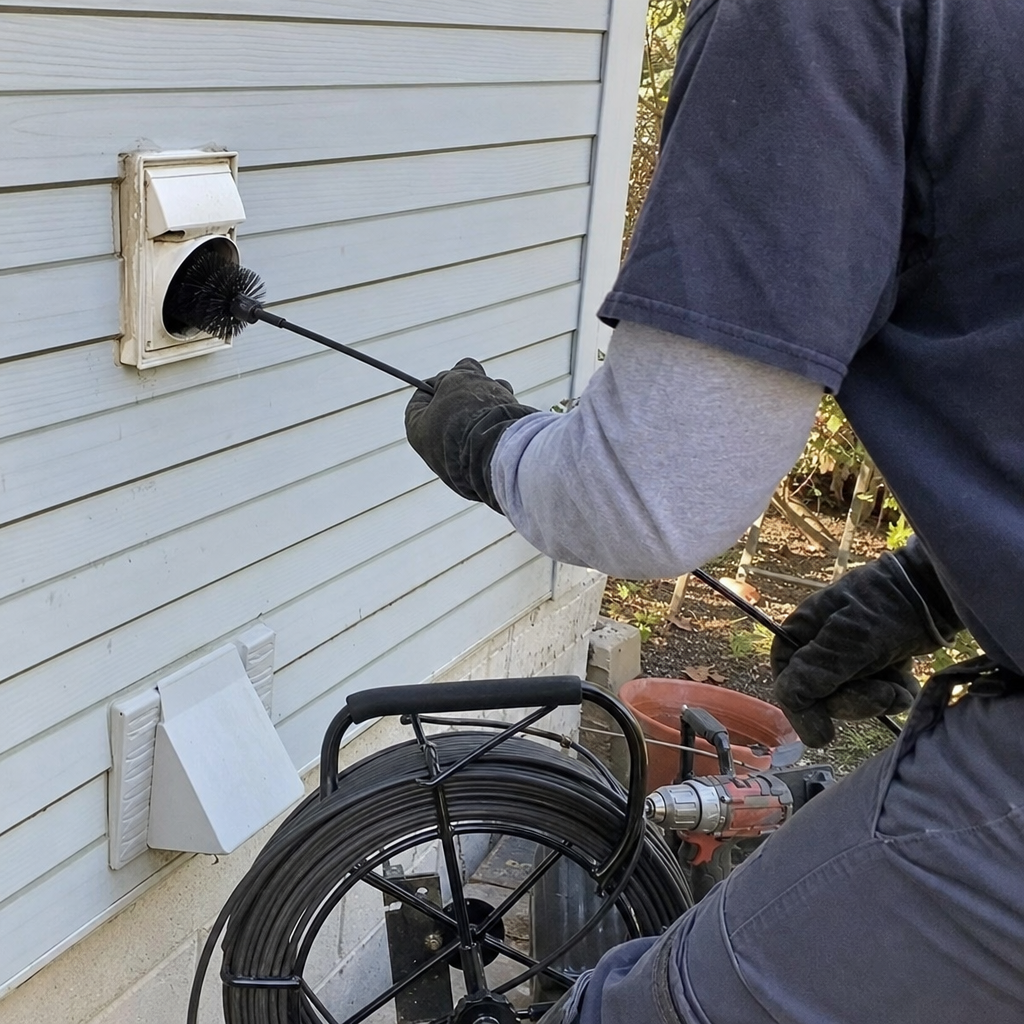
- Ignoring the dryer vent. Lint-clogged dryer vents create backpressure that can compromise adjacent ductwork and present genuine fire risk. Dryer Vent Cleaning in Manchester and Hartford should be on the same maintenance calendar as duct cleaning.
- Waiting for “signs” of dirty ducts. By the time you smell mustiness or see dust plumes, the problem is advanced. Proactive maintenance per this checklist prevents the conditions that create visible symptoms.
- Hiring based on coupon price alone. The $99 duct cleaning specials in Hartford typically involve a shop vacuum and 45 minutes. We’ve been called to remediate systems where “budget” cleaning dislodged debris without extracting it, leaving homeowners worse off.
- Neglecting HVAC coil and blower cleaning. The coil is the wettest, most microbially active surface in your system. Clean ducts with a filthy coil means immediate recontamination. HVAC Cleaning in Manchester and Hartford addresses the full system, not just distribution paths.
- Documenting nothing. Without baselines, every future decision is emotional rather than evidence-based. The fifteen minutes of documentation described above pays dividends for years.
When to Call a Professional
Some conditions exceed homeowner maintenance scope and require trained assessment with professional-grade equipment. Call for inspection when you find:
- Visible mold or persistent musty odor from any register
- Disconnected, crushed, or rodent-damaged flex duct
- Weak airflow in specific rooms that doesn’t improve with filter change
- Post-renovation dust contamination, especially from drywall or sanding
- Recent pest infestation (rodents, insects) in ductwork or near air handler
- System hasn’t been professionally cleaned in 5+ years
Empire Air Duct Cleaning Service Greater Hartford offers free estimates in Hartford and surrounding towns — call (844) 923-4376. Steven Ramirez leads every job personally, so the person who assesses your system is the same technician who performs the work. With 14 years of owner-operated experience and over 1,000 verified five-star reviews, we provide the accountability that crew-rotation companies cannot guarantee.
Frequently Asked Questions
Most Hartford homes benefit from professional duct cleaning every 3 to 5 years, with shorter intervals for homes with multiple pets, recent renovations, or occupants with respiratory sensitivities. Homes near major pollen sources or highways may need cleaning every 2 to 3 years. Call (844) 923-4376 for a free assessment of your specific situation — estimates are free.
No — consumer-grade vacuums lack the CFM and agitation capability to dislodge adhered debris from duct interiors, and improper technique can damage flex duct or push contamination deeper into the system. For safe, effective cleaning, professional equipment like the Rotobrush and Nikro systems we use is necessary. Call (844) 923-4376 to discuss what’s actually needed in your home.
Musty startup odors typically indicate microbial growth on the evaporator coil or in the condensate pan, not necessarily dirty ducts — though the two conditions often coexist. Hartford’s humid summers create ideal conditions for coil contamination. The smell usually diminishes as the coil dries, but the underlying growth continues. Professional HVAC cleaning addresses the source, not just the symptom.
Yes, but with important caveats. Pre-1940 Hartford homes often use wall cavities as return air paths, which cannot be mechanically cleaned. However, the supply ductwork — typically metal in homes of this era — can be thoroughly cleaned, and sealing accessible leaks reduces infiltration of plaster dust and debris. We’ve restored airflow and air quality in dozens of Hartford’s historic homes with this targeted approach.
Request before/after photos from inside the ductwork, not just register surfaces. Verify the scope included supply and return trunks, not just accessible branches. Ask whether the coil and blower were inspected — clean ducts with a filthy coil means immediate recontamination. At Empire Air Duct Cleaning Service Greater Hartford, Steven documents the full scope with photos as standard practice.
Duct cleaning addresses the distribution network — the pathways that carry air to and from rooms. HVAC cleaning includes the air handler components: evaporator coil, blower assembly, condensate pan, and heat exchanger. For complete system health, both are necessary. We offer full-system air quality services so one call resolves the complete picture, not just one component.
The Bottom Line
Effective duct maintenance in Hartford isn’t about following a generic quarterly calendar — see more guides & resources for seasonal timing — it’s about understanding how our specific climate, vegetation, and housing stock interact with your system. Filter changes timed to pollen peaks, annual inspections for flex-duct damage in attics and crawlspaces, and documented baselines after professional cleaning separate maintained systems from neglected ones. The fifteen minutes of inspection described in this checklist, performed twice yearly, prevents the conditions that lead to expensive remediation. For everything beyond homeowner scope, Steven Ramirez leads every job personally with professional-grade Rotobrush and Nikro equipment, backed by 14 years of owner-operated experience and over 1,000 verified reviews.
Written by Steven Ramirez, Owner & Lead Technician at Empire Air Duct Cleaning Service Greater Hartford, serving Hartford since 2012.