
Last updated September 3, 2026
Air Duct Cleaning Permits, Codes & Inspections in CT: What You Need to Know
The contractor who finished the job in two hours and handed you a receipt may have left you with an unpermitted modification inside your wall cavity. In our 14 years serving Hartford, we’ve been called in after homeowners discovered their “simple” duct cleaning included sealed joints, replaced flex duct, or reconnected trunk lines that never passed inspection. Connecticut’s mechanical code draws a sharp line between maintenance and modification — and most homeowners don’t learn where that line sits until they’re selling their house or filing an insurance claim. This guide explains what duct work actually requires permits in Connecticut, how to protect yourself from liability, and how to hire an air duct cleaning contractor in Hartford with the right questions before any work begins.
Quick Answer
Air duct cleaning itself — the removal of dust and debris from existing ductwork — does not require a permit in Connecticut. However, duct sealing with mastic, liner replacement, duct repair, or any modification to the distribution system typically triggers permit requirements under the Connecticut Mechanical Code and must be performed by a licensed HVAC contractor. If your home was built before 1978 in Hartford or surrounding towns, additional asbestos disclosure and handling requirements apply to any work involving duct insulation or aged tape materials.
Table of Contents
- What the Connecticut Mechanical Code Actually Says About Duct Work
- Maintenance vs. Modification: The Permit Line Every Homeowner Should Know
- When Duct Sealing and Mastic Application Require a Licensed HVAC Contractor
- Asbestos Disclosure for Pre-1978 Hartford Homes: What Contractors Won’t Always Tell You
- Five Questions to Ask Your Contractor Before Work Begins
- What to Document After Any Duct Work for Future Sales and Insurance
- Common Mistakes to Avoid
- When to Call a Professional
- Frequently Asked Questions
What the Connecticut Mechanical Code Actually Says About Duct Work
Connecticut adopts the International Mechanical Code (IMC) with state amendments, and the distinction between cleaning and altering your duct system matters more than most homeowners realize. The code requires permits for “installation, alteration, repairs, relocation, replacement, or addition” to mechanical systems — but explicitly excludes “routine maintenance” from permit triggers.
Here’s where Hartford’s older housing stock complicates things. In neighborhoods like West End, Asylum Hill, and South Green, we regularly encounter galvanized steel ductwork from the 1950s and 1960s with original asbestos-containing duct tape at every joint. The Connecticut Department of Public Health mandates that any disturbance of asbestos-containing materials requires notification, proper containment, and disposal by a certified abatement contractor — not just a duct cleaner with a vacuum.
The practical implication: if your contractor opens a section of duct and finds degraded insulation or tape, they cannot legally continue without stopping the job and engaging certified asbestos handlers. We’ve seen too many quick-turnaround operations in Hartford County simply remove visible material and move on, leaving homeowners with undocumented asbestos disturbance in their air handling system.
Key permit triggers under Connecticut’s amended IMC include:
- Replacement of any duct section longer than 10 feet
- Sealing of joints with mastic or tape where the original connection method is altered
- Installation of duct liner or removal of existing liner
- Modification of return air pathways or addition of return vents
- Reconnection of ducts after HVAC equipment replacement
Permit-exempt maintenance includes mechanical brushing and vacuum extraction of existing ducts, provided no physical alteration occurs to the duct structure or connections.
Maintenance vs. Modification: The Permit Line Every Homeowner Should Know
The Connecticut State Building Inspector’s office and local building departments across Hartford County interpret the maintenance exemption narrowly. In our experience working from Bloomfield to East Hartford, the specific test is whether the work changes the “design, capacity, or performance characteristics” of the system.
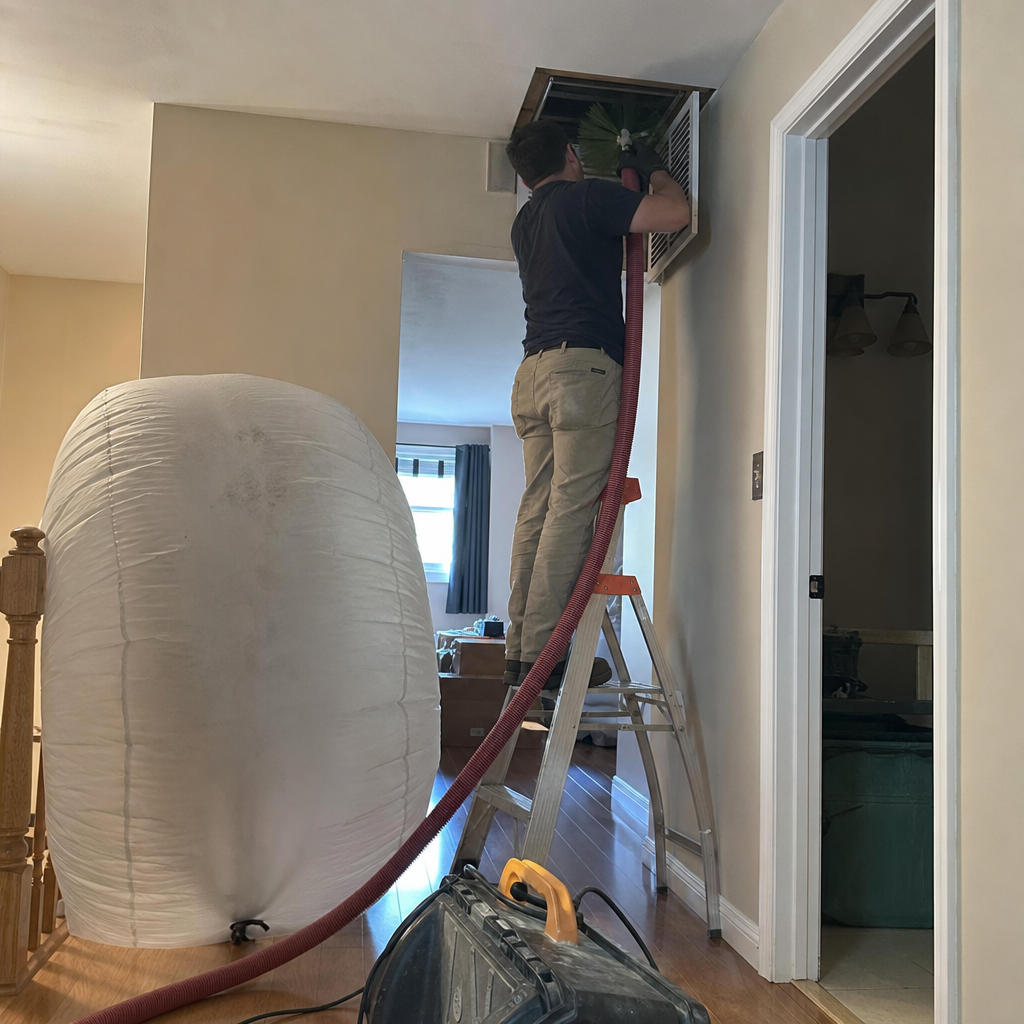
A Rotobrush system extracting dust from a 6-inch round duct? Maintenance. Removing that same duct to access a blocked trunk line, then reinstalling it with new flex connections? That’s modification requiring permit and licensed HVAC oversight.
The gray zone catches most homeowners. Consider these scenarios we’ve encountered in Hartford homes:
- Scenario: A dryer vent cleaning reveals the transition duct behind the dryer has separated from the wall penetration. The technician reconnects it with a new clamp and foil tape.
Permit status: Likely requires permit as “repair” to the exhaust system, though many contractors skip this. - Scenario: During air duct cleaning in a 1920s West Hartford colonial, the technician discovers a collapsed flex duct in an unconditioned attic. They replace the 12-foot section.
Permit status: Definite permit trigger — duct replacement alters system capacity and requires licensed HVAC contractor, not cleaning specialist alone. - Scenario: Post-renovation cleaning in a South Windsor home finds construction debris packed in return air ducts. The technician uses compressed air and vacuum extraction only.
Permit status: Exempt maintenance, provided no physical duct alterations occur.
The climate factor matters here too. Hartford’s freeze-thaw cycles and humid summers stress ductwork in unconditioned spaces. We’ve seen “simple” cleanings reveal deteriorated connections that a thorough technician must address — but addressing them properly means stopping, permitting, and engaging the right license holder.
When Duct Sealing and Mastic Application Require a Licensed HVAC Contractor
This is where most homeowners get surprised — and where we’ve had to educate even experienced property managers in Hartford’s condo market.
Duct sealing with mastic or aerosol sealant crosses into mechanical work when it involves:
- Accessing internal duct surfaces through cut openings that must be reclosed
- Application of sealant to joints that were previously unsealed or mechanically fastened only
- Sealing of plenum connections or equipment attachments
- Use of pressurized aerosol systems that require temporary duct blocking and airflow manipulation
The Connecticut Department of Consumer Protection licenses HVAC contractors specifically for “the installation, repair, replacement, maintenance or alteration of air conditioning, refrigeration, heating or ventilation systems.” Duct sealing that modifies system airflow characteristics falls squarely within this scope.
Here’s what we’ve observed in Hartford’s competitive market: some duct cleaning companies offer “sealing” as an add-on, applying mastic to accessible joints from the register side without pulling permits or disclosing that the work technically requires licensed HVAC oversight. The homeowner gets a cleaner system and temporarily better airflow, but no documentation that the modification occurred.
When we encounter degraded seals during cleaning in Hartford homes — particularly in the older multi-family stock of Parkville and Barry Square — we stop and explain the situation. If mastic application is needed, we coordinate with licensed HVAC partners or advise the homeowner to engage one directly. Steven leads every job personally, and that accountability means we don’t blur lines that could leave a homeowner exposed.
The equipment distinction matters too. Our professional-grade Rotobrush and Nikro systems are designed for extraction, not modification. We can document what we find. We can clean what we access. But when the solution requires altering the duct system itself, we flag it and connect you with the right licensed resource.
Asbestos Disclosure for Pre-1978 Hartford Homes: What Contractors Won’t Always Tell You
Hartford’s housing inventory skews older than the national average, with significant concentrations of pre-1950 construction in neighborhoods like Clay-Arsenal, Behind the Rocks, and Upper Albany. Before 1978, asbestos was common in:
- Duct insulation wrap (particularly on basement trunk lines)
- Duct tape at joints and seams
- Furnace gaskets and boiler insulation
- Vermiculite insulation in attics containing ducts
Connecticut’s asbestos regulations, administered by the Department of Public Health, require that any building material suspected of containing asbestos be treated as asbestos-containing until proven otherwise through laboratory analysis. This isn’t optional — it’s a strict liability framework that applies to contractors and can attach to homeowners who knowingly allow improper disturbance.
The disclosure gap we’ve encountered: many duct cleaning contractors in the Hartford market either don’t ask about construction date or assume visual inspection suffices. We’ve been in homes where previous cleaners brushed directly over friable asbestos tape, aerosolizing material into the living space without containment or negative air pressure.
Proper protocol for pre-1978 Hartford homes includes:
- Pre-work survey questioning construction date and any known asbestos documentation
- Visual inspection of accessible ductwork for suspect materials
- If suspect materials are present: stop work, recommend certified asbestos inspection (typically $400–$800 in Hartford market), and schedule cleaning only after clearance
- If no suspect materials are visible: proceed with standard cleaning protocols, document condition with photos
The cost of skipping this step can be severe. We’ve consulted with homeowners facing $15,000–$40,000 abatement bills after improper disturbance during “routine” cleaning, plus potential health liability exposure. In a 2019 case in Wethersfield, a homeowner’s insurance denied a claim because the duct work was performed by an uncertified contractor who failed to follow asbestos protocols.
Five Questions to Ask Your Contractor Before Work Begins
After fourteen years and over 1,000 verified reviews, we’ve learned that informed homeowners get better outcomes. For more guides & resources on protecting your home, explore our blog. Ask these questions directly — and be wary of evasive answers:
- “Will this work require any permits, and if so, who’s pulling them?”
A direct answer is either “no, this is maintenance-only cleaning” or “yes, and here’s the permit number/contractor license.” Vague responses about “not needing to worry about that” are red flags. In Hartford, permits are filed with the city’s Licenses and Inspections Division or the relevant town building department. - “Are you licensed for HVAC work in Connecticut, or are you a cleaning specialist?”
There’s no shame in being a specialist — we are one. But the answer should be honest. If they claim dual capability, ask for the HVAC license number and verify it through the Connecticut Department of Consumer Protection’s online lookup. - “What happens if you find asbestos or suspect materials during the job?”
The correct answer: stop work, contain the area, and recommend certified abatement assessment. Any answer suggesting they can “work around it” or “seal it in place” during cleaning should end the conversation. - “Will you document the pre-existing condition of my ductwork, and what form does that documentation take?”
We provide dated photo documentation of accessible duct conditions before and after cleaning. This protects both parties and creates a record for future transactions. - “If your cleaning reveals needed repairs, what’s your protocol?”
The ethical answer: stop, explain, and recommend licensed HVAC repair. The dangerous answer: “We can take care of that too, no need for another contractor” — especially if no permit is mentioned.
What to Document After Any Duct Work for Future Sales and Insurance
Hartford’s real estate market increasingly demands disclosure of mechanical system work. We’ve had sellers call us years after service to request documentation for buyer inspections. Here’s what to maintain:
- Original service agreement specifying scope as “cleaning only” or listing specific modifications
- Permit documentation if any modification occurred, including final inspection sign-off
- Contractor license information — HVAC license numbers for any mechanical work
- Before/after photos of duct conditions, particularly if damage or suspect materials were found
- Asbestos inspection reports if applicable, with laboratory results
- Equipment specifications for any replaced components (brand, model, capacity)
For insurance purposes, documentation proves that work was performed to code by qualified professionals. In fire or water damage claims involving duct systems, insurers increasingly investigate whether prior modifications contributed to loss spread. Unpermitted duct modifications have been cited in claim denials across Connecticut.
We maintain records of every Hartford-area job we’ve performed since 2012. When past clients need documentation for transactions or claims, we can provide detailed scope descriptions and dated photo evidence. This is the accountability that comes with owner-operated service — Steven handled the job, and Steven can attest to what was done.
Common Mistakes to Avoid
- Assuming “cleaning” covers everything in the estimate. Some Hartford-area contractors scope-creep from cleaning into sealing or minor repairs without clear discussion or permit awareness. Read your agreement carefully — if it mentions “restore airflow” or “repair connections,” question whether that’s cleaning or modification.
- Accepting verbal assurance that permits “aren’t needed for this.” Connecticut’s permit exemption for maintenance is specific and narrow. If your contractor won’t put the permit status in writing, that’s a warning sign.
- Ignoring construction date in older Hartford neighborhoods. Homes in Frog Hollow, North End, and South End frequently contain asbestos materials that younger technicians don’t recognize. Always disclose pre-1978 construction and ask about asbestos protocol before work begins.
- Letting cleaning proceed after damage is discovered. We’ve seen contractors continue brushing and vacuuming after finding collapsed ducts or separated joints, “fixing” problems hastily to finish the job. This creates unpermitted modifications with no documentation. Stop the work and reassess.
- Discarding documentation after “routine” service. Even cleaning-only visits create a record of system condition. Keep service agreements and any photos for the life of your homeownership — they’re valuable at sale and for warranty claims.
- Hiring based on lowest price without verifying scope. Hartford’s market includes operators who underbid by skipping asbestos assessment, avoiding permit costs, or using consumer-grade equipment. The $89 whole-house special rarely includes proper protocol.
- Failing to verify contractor specialization. Generalist HVAC companies sometimes treat duct cleaning as loss-leader upselling, while dedicated cleaners may lack HVAC licensing for discovered repairs. Know which you’re hiring and what they can legally perform.
When to Call a Professional
Call for professional assessment when you notice reduced airflow, visible dust emission from registers, persistent odors after cleaning, or any contractor recommendation that involves “opening up” or “replacing” duct sections. In Hartford’s climate, seasonal temperature swings also stress older systems — fall and spring are optimal timing for inspection and maintenance before heating or cooling demand peaks.
Empire Air Duct Cleaning Service Greater Hartford offers free estimates in Hartford and surrounding towns — call (844) 923-4376. Steven Ramirez personally evaluates every job, documents findings with photos, and clearly distinguishes what we can clean from what requires licensed HVAC or asbestos-certified partners. With 14 years, one standard, we’ve built our 1,074 verified reviews on transparency about what we do, what we don’t, and what your system actually needs.
Frequently Asked Questions
No — standard air duct cleaning, defined as mechanical brushing and vacuum extraction of existing ductwork without physical alteration, does not require a permit under Connecticut’s amended International Mechanical Code. For full details, see The Complete Guide to Air Duct Cleaning in Hartford. However, if your contractor discovers damage and proposes repairs, replacement, or sealing that modifies the duct system, permit requirements likely apply and should be handled by a licensed HVAC contractor. Call (844) 923-4376 for a free estimate — we’ll assess whether your job is maintenance-only or requires additional licensed coordination.
Duct sealing that involves mastic application to internal joints, aerosol sealant injection, or modification of existing connections typically requires a Connecticut HVAC contractor license and may require permits. A cleaning specialist without HVAC licensure can clean your ducts but should not perform sealing work that alters system performance. We coordinate with licensed HVAC partners when our cleaning reveals sealing needs in Hartford homes.
Disclose the construction date to your contractor and ask specifically about asbestos protocol for duct tape and insulation materials. In Hartford’s pre-1978 housing stock, we routinely encounter asbestos-containing materials that require certified abatement handling before cleaning can proceed safely. Never allow brushing or disturbance of suspect materials without proper containment and disposal procedures.
Contact the building department where the work occurred — Hartford’s Licenses and Inspections Division for city properties, or the relevant town clerk for suburban locations. Permits are public record and should show the scope, contractor license, and inspection status. For work performed by Empire Air Duct Cleaning Service Greater Hartford, we provide written scope documentation that specifies whether permits were required and obtained.
Yes — Connecticut’s residential property disclosure form requires sellers to report “structural or mechanical system modifications made without required permits.” Unpermitted duct modifications discovered during buyer inspection can delay closing, trigger re-inspection requirements, or become negotiation points. Documentation of permit status protects your transaction value.
Air duct cleaning addresses the distribution network — the supply and return ducts that move conditioned air throughout your home. HVAC Cleaning in Manchester and equivalent full-system service encompasses the air handler, coils, blower, and often the duct network as an integrated system. In Hartford’s climate with heavy heating-season use, full HVAC cleaning addresses components that duct-only service cannot reach. We offer both scopes and can recommend the appropriate service based on your system’s condition.
The Bottom Line
Connecticut’s mechanical code creates clear boundaries between maintenance and modification, but those boundaries are invisible to homeowners until something goes wrong. The key protections are simple: ask direct questions about permits and licensing, demand written scope documentation, disclose your home’s construction date for asbestos assessment, and never allow scope-creep from cleaning into repair without proper credentials. In Hartford’s older housing market, these precautions aren’t bureaucratic excess — they’re the difference between a properly documented service and a liability that surfaces years later. The contractor who knows the rules and follows them will welcome your questions. The one who doesn’t may be the reason you’re asking them later.
Written by Steven Ramirez, Owner & Lead Technician at Empire Air Duct Cleaning Service Greater Hartford, serving Hartford since 2012.